
Review: The Heavens, Sandra Newman
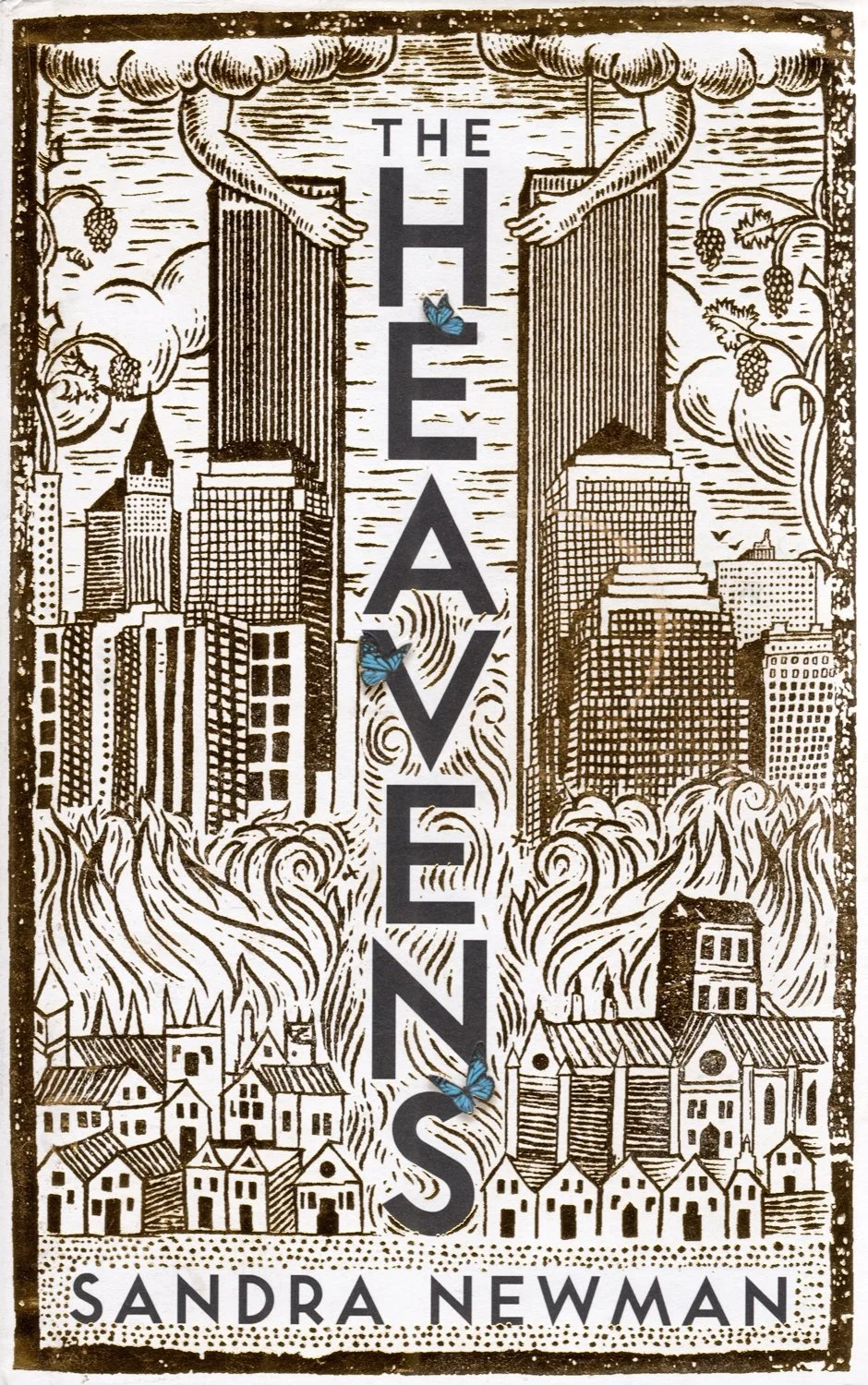
It’s galvanising, creatively speaking, when someone capable, and well-supported, comes up with a great idea, then fumbles the execution. I’m not speaking of schadenfreude, the critical equivalent of a comedically large prop knife with a ragged handle. This also isn’t a case of disliking a book because it isn’t what I personally wanted it to be, either. I wanted Newman to pull off a time-travel mind-meld meet-cute with grand aplomb. It’s a great idea. It’s her fourth book. Her prose is gorgeous.
And yet.
Our protagonist Kate lives in New York at the turn of the millennium, in an alternate world more progressive than our own. At a very fancy party she meets Ben, a perfectly nice young poet, and romance blossoms in utopia. Trouble is, when Kate falls asleep, her mind travels to Elizabethan England, where she is burdened with visions of apocalypse, and when she wakes, her present has changed, never for the better. As her relationship with Ben falls apart, mirroring a death-spiral America, an affair blossoms in 1593 with an obscure playwright called William.
It’s Shakespeare in Love meets The Butterfly Effect – epic in scope, rich with narrative possibility, and certainly Newman has the lyrical skill to do the concept justice. It just sometimes feels as if, once the idea found her, she didn’t know what to do with it.
The fumbling begins almost immediately, with world-building that reads more like a left-wing fantasy than a lived-in universe. An eco-conscious immigrant woman is President of the United States, elected on the back of a campaign funded by left-wing millionaires. UBI has been implemented, pollution is at an all-time low, protests are held nationwide unhindered by police, and it is the first year without a war anywhere in the world.
Are you annoyed by this utopia? Because I was. Or rather, I was annoyed by Newman’s entry-point: the rich-girl party hosted by Kate’s best friend (and one of President Chen’s financiers), Sabine. A multi-millionaire’s daughter, she allows all manner of interesting society to live, rent free, in her father’s multi-story Manhattan penthouse, including gay architects, environmental activists, ex-military veterans, and a Ukrainian filmmaker CEO of a mail-order bride rescue organisation. The next morning, this exceedingly civilised bunch gather for breakfast, where Sabine’s servants jokingly chase well-meaning hungover artists away from the kitchen.
It’s unfair to expect a utopia to follow all the same rules as reality – after all, if we lived there, we’d be home by now. But break enough rules, or break foundational rules, and readers familiar with genre fiction – or even just the concept of cause and effect – begin expecting explanations. What change occurred to the fundamental governing principles of the world we know, to allow for this fantasy? Where is the through-line?
Here’s a foundational principle: you cannot be a millionaire and be socialist. You can at best be a very philanthropical capitalist, but the means by which someone amasses a million of anything involves a level of extraction and exploitation and hoarding that is incompatible with socialism. Ideologies have boundaries, and if you step outside those boundaries, you step outside those ideologies. That’s how ideology works. That’s how definitions and language work. Point at a capitalist and tell me a they’re a socialist, and they only become a socialist if we both agree to completely change the definition of a socialist.
So, if you’re going to serve up a mega-wealthy heiress as the lynchpin to a utopia in which everyone has enough to be satisfied – including lawful good millionaires – you’ve got some explaining to do. Sabine is culturally progressive, financially [redacted], exoneration enough for the upper class socialites she surrounds herself with. But not exoneration enough for me. In this context, Universal Basic Income - an actual implementable real-world initiative that, should it come to pass, would require the sort of wealth redistribution and taxation on the super-rich that would make Sabine’s wealth unlikely - is assumed so patently impossible, it seems to have only been included in order to confirm the unreality of this utopia.
It only gets worse once we leave the penthouse. Those beautiful protests, those beautiful protestors – Newman never specifies what exactly they’re protesting against; without demands or grievances, isn’t a protest just a party? That’s the neoliberal platonic ideal of a protest: toothless and inconsequential, with no target or outcome, but it sure does make you feel good for taking part. And let’s talk about Sabine’s servants, because nobody else does! While we’re at it, who’s collecting this utopia’s bins? Who’s driving the buses? Who’s exterminating the rats in the subway? The least glamorous job in this book is Ben’s gig as an office worker, for a green energy company no less. The vast majority of blue-collar workers and poverty-labourers upon whom the world depends are conveniently invisible, and remain unseen as the utopia turns to dystopia, despite no doubt bearing the brunt of the world’s increasing misery.
So from the outset, I couldn’t shake the feeling that all these progressive achievements were being reduced to hasty window-dressing, leftist tinsel thrown over a stubbornly neoliberal worldview, rather than anything genuinely utopian in spirit. To give Newman the benefit of the doubt, perhaps we’re meant to find this annoying. Perhaps the novel’s opening gambit is meant as satire, these wealthy socialites intended as a faintly ridiculous fantasy version of the harbingers of a socialist paradise that will never come to pass. Perhaps we, the left-leaning reader, are being asked to be realistic about our expectations, and to work towards them with a little more self-awareness. Perhaps this utopia is slyly asking us to ditch the impracticalities of idealism.
But I genuinely think we’re meant to envy these characters. Newman’s prose, luscious and nimble, only threatens them with very minor character assassinations. Sabine’s a voracious gossip, but otherwise a good egg, putting her narratively unlikely privilege to work saving rare species of grass, or housing refugees. The gay architect’s a bitchy lush, but otherwise bearable, even despite the borderline cliche caricature of a gay architect. The mail-order bride rescuer, Oksana, is haughty and pretentious, but she does walk around the party buck naked and nobody cares, assuring the reader that misogyny has finally been defeated. Middle-class Ben finds these creative directors and wealth-managers charming without envying or questioning their privilege, lending their alternate universe a rosy hue it never materially earns.
The upshot of this annoying utopia is, Kate and Ben are also annoying. She’s a manic pixie dream girl minus the manic; she just sort of hangs about Sabine’s flat for three quarters of the book waiting for her story to gain some momentum. He’s a boy with so little interesting about him, the most interesting thing about him is, he’s hyper-aware there’s very little interesting about him. Does this feel familiar, dare I say even a little tropey? In the words of our own dystopian overseer, many such cases! And so these two star-crossed lovers connect because in this dream-world, love at first sight exists – after all, there’s little else to bring them together. Yes, as Kate dreams the world closer to apocalypse, everyone becomes more interesting, but they don’t become more believable. Any interest they accrue exists as a deviation from their perfect selves, who are, at least in my eyes, damned by the political shonkyness of the utopia that created them.
Again, I want to reiterate: there is is a killer idea buried in here somewhere. The core tension of a romance comes from pitting two people against the harsh realities of the world – but what if the world wins, and what if we’re all complicit in creating that world? A story worth telling, I think. Yet, because these characters don’t hold many material connections to the world beyond their penthouse party, their journey away from their startlingly flat ideal selves remains restricted to the emotional, never the material, and the worldly conflict inherent to a romance never truly arrives.
Of course, Kate and Ben, New York, alternate 2000, is only half the story. Perhaps Kate and Shakespeare, 1593, provide the necessary explanation, the conflict, the redemption? I’m… not so sure.
I’ll admit, not being a huge fan of period dramas, I’m not best placed to comment on the accuracy of Newman’s portrayal of England, 1593, except to say: her descriptions of artists and politicians and courtesans escaping an outbreak of plague in a rural manor are exactly as lovely as her descriptions of artists and politicians and courtesans enjoying a penthouse party in post-millenial New York. Newman’s prose flows smooth and lively as a flute solo, and as for her frequent giddy flourishes of language – a harsher critic might call them darlings – almost all land gracefully. Like I said, she is capable. And yet. The dialogue; oh man, the dialogue. It’s very hammy. Take, for example, this extract from when Kate first meets “Sad Will”:
Kate: “Tis a brave man who jests of pipes and nothings, whilst in London our friends are laid into their graves.”
Will: “If it be a crime that I am merry, I am sorry for it. Certes, madam, the pestilence is no friend to us. As you see, we must wander abroad to seek our food […] As you see us, we are very Toms o’ Bedlam, beggars with no man’s love.”
My English Literature degree is twenty years out of date, so take this with a pinch of salt, but – wasn’t Shakespeare’s dialogue fancy and frilly even for his own time? Plays and poems of his contemporaries exist that aren’t half as stylised. People of the 1600s of course spoke different to people in the 2000s – hell, we talk different to how we spoke in the 2000s – but they didn’t talk like this. So it’s jarring, hearing everyone in Kate’s dream-past talk like they’re performing at the Globe theatre, all prithee, sires and ye olde codswallop. It’s as if, instead of Kate’s mind travelling to Shakespeare’s time, she’s instead dreamed herself into a biographical drama Shakespeare never wrote.
This is where my real troubles with The Heavens begin (yes, I know, extreme Meryl Streep voice: now a warning?). It’s a well-worn trope that once a character starts universe-hopping, their peers doubt their grasp on reality, leading the protagonist to entertain the strong possibility that the other universe really is all in their head. And that does happen here: when Kate shares her dreams as a teen, the heightened unreality attracts suspicion, and her increasing inability to recognise her adult life is diagnosed as a sort of schizophrenia. Even within the dreams, the version of Kate in 1593 barely remembers herself in the future, doubting the veracity of her visions of apocalypse.
But here’s the kicker: this trope only works when one universe is markedly more believable than the other. The conflict comes from the choice the character has to make: overcome doubt in the dream to embrace the unreal, or abandon fancy to accept reality? And it does have to be a choice, or nothing actually matters – more on that shortly. However, when we begin The Heavens, with one foot in an ideologically empty utopia, the other in a chronically self-aware period drama dream, both universes feel unreal. There’s no no indication which universe or timeline we, the reader, are meant to believe Kate absolutely exists in.
I can see a purpose to this nothingy set-up: it makes our timeline, where Kate eventually arrives, feel more real. Given the cover of the book – and the content of this review – I don’t think it’s a spoiler to say, when Kate catches up with our reality, she does so on the day of 9/11. And indeed, that chapter is gripping in a kind of rich-people-in-peril sort of way, but also due to Kate’s discombobulation, cut adrift from the event’s real-world significance. It is in this chapter where the book’s epic sense of time is severed from a necessary corresponding epic sense of space, and the entire construction suffers as a result. It feels like a boulder dropped into a still lake, a monumental, ripple-causing event that nobody could predict or prevent. When in reality, our reality, it was very much a predictable, preventable ripple in its own right, the result of centuries-long cause-and-effect on an international scale.
The problem is, in order to get there, we first spend three quarters of the book bounced untethered between unrealities, and it gets tiring. Especially as the changes Kate causes aren’t, for quite some time, apparent to anyone but Kate, and being a manic pixie dream girl minus the manic, neither version of her does anything about it. In 2000, she merely observes the variations and tries not to sound too crazy around Ben and Sabine. In 1593, she knows she has to do something to avert catastrophe, but rather than seek out that averting action, she instead fucks Willy Shakes more often than might be expected of a girl with a destiny calling.
Early on, The Heavens goes out of its way to reference the butterfly effect (small actions snowballing into notable events) and the great man theory (history is constructed by the destruction of the status quo by individuals possessing inherent superiority). But even while staring down the barrel of an apocalypse she herself seems to be creating, Kate neither takes actions, even small ones, nor does she attempt to use her unique ability to change the future. The world just sort of happens – and falls apart – around her.
Is there something to pick up here, about complacency making us complicit in creating an imperfect world? Sure there is. Does Newman pick it up? Not really! Is Kate’s lack of agency the direct cause of the degradation of her utopia? Turns out: no! And if you thought this book couldn’t withstand more big ideas, [leans into frame] sir, a fifth high concept has hit the novel.
Shakespeare himself is also a time-traveller – he dreamed into the past to become right hand tactician and fuckboy to Alexander the Great. Alexander dreamed into the past to become Cassandra at Troy. Late in the book, Kate meets another time-traveller, an ex-marine who visits her in his dreams, and he explains – or rather, lore dumps – that he himself is visited by an academic who, in her own time, studies this process of star-crossed time-travellers, and she was visited by the scientists who began the whole fandango, in the process destroying all life, everywhere. All woke from their dreams of the past to a world none could prevent becoming worse, and in return they were rewarded with greatness in their own time.
Kate does by the end of the novel finally step into the beginnings of that greatness, but it very much is thrust upon her narratively, because that’s the maguffin’s reward for not dying in the dystopia she created. Mostly what agency she does exert amounts to taking part in community outreach, which isn’t quite on the same level of Shakespeare, Alexander or Achilles. There’s something to speak on there, too – great men don’t have to be heroes, they can be great women working on the level of social support – but that’s exactly where the book ends, so it’s a thought that never goes anywhere. And still, Kate’s efforts in this realm also only exist thanks to the material support of a somewhat reduced version of a still really quite privileged Sabine, annoyingly the most interesting character, despite her wealth undercutting the book’s political optimism.
So: two unrealities. One stable and endurable, but it happens to be your fated lover’s apocalypse dream come true. One becoming progressively worse, but more like our own reality, with a personal consolation prize at the end. Listen, listen: that should work. It’s majorly depressing. Cynical in the extreme. But it should work.
And yet.
Here comes a side note that’s not really a side note: the ex-marine from the twenty-fifth century describes the academic from the twenty-ninth century as a trans woman, and look, you are not convincing me that our current understanding of gender progresses so little in the next 800 years, that folk in 2800 still describe themselves – or even conceive of themselves – with terminology from the early twenty-first century. And perhaps he’s only using language he knows Kate, in 2000, will understand. But I do think that gets to the crux of my annoyance: in a book explicitly about small actions leading to great changes, nothing changes.
And that’s when it clicked. For a work of time travel and alternate realities, there’s very little that feels genuinely of a different time, or a different world. With that realisation locked in, a whole host of narrative and ideological assumptions wriggled out from under the apparently unpredictable, impossible boulder of 9/11.
A very familiar worldview begins to take shape underneath the story. Empire haunts this book, and not in a good way. Troy. Macedon. Britain. America. The Future. The novel’s core message seems to be: nation states may fall, but love remains. A beautiful, human sentiment.
Unfortunately, sentiment is as far as The Heavens wants to go.
In their meet-cute, Kate and Ben share their heritages – Bengali-Jewish, Hungarian-Persian respectively – but nothing recognisable, material or emotional of this history makes itself known. If they hadn’t divulged their identities in the first chapter, I could have read the entirety of the book assuming they were White Anglo-Saxon Protestants. Their international identities are reduced to more window-dressing. Add to this, The Heavens’ “great men” overwhelmingly fall within the Euro-Western canon. What of the rest of the world – are there no “great men” outside of the global north, do their small actions not domino into great events? Perhaps, but they aren’t the focus of this story.
The colonisation of America isn’t once mentioned, and Native Americans feature nowhere in the initial utopia – or indeed, the entire book. Yet, The Heavens’ utopian New York is structurally identical to our own, albeit with no homeless people and better bagels. So some kind of recognisable history connects all versions of this New York to the real New York, which in the long game is a direct product of colonisation. So in The Heavens’ utopia, the violent settlement of America must have happened, as it did in reality, sometime between Hamlet and the Iraq war; we know the French have something to do with it because everyone’s bilingual, but that’s the only clue you’re getting as to what happened when the West discovered the West.
Perhaps I’m being too harsh? After all, The Heavens was published in 2019. Both its utopia and dystopia might have landed differently with me in a world that was pre-COVID (although pandemics have always shaped history), pre-BLM (although people of colour have always resisted white supremacy), pre-Russian invasion of Ukraine (although empire has always required war), pre-Israeli genocide in Palestine (although Israel has always been, from the beginning, an exercise in extermination), etc and so on. Then again, perhaps the sentiment of The Heavens resonates more fully, if you aren’t in the habit of paying much attention to anything happening beyond the high, high windows of the penthouse party that is middle-to-upper-class North America.
But functionally, there is no distinction here between utopian or dystopian. The world operates as it always has done. Kate’s journey from one to the other feels like watching a Let’s Play of an RPG that lets you bump the sliders during character creation, but none of it ever affects the gameplay. Despite the arc of history bending towards less human strife in general, The Heavens only invokes utopia to imply our current dystopia is all but inevitable. Newman is content to rewrite history, but only if it doesn’t point to a markedly different present.
And if the world tends towards disaster no matter what you do, the only sane approach seems to be not getting too bothered about it.
Party on.
2025: The Best Bits
I know you’re expected to do these sorts of year-end write-ups in December because there’s something gauche about looking back so immediately after the new year begins. Maybe this year I’ll be organised enough to do so, but last year, I was not. So! Here’s a quick run-down of events, achievements and discoveries that made 2025 (at time of writing not even 24 hours deceased) bearable and, at times, even enjoyable.
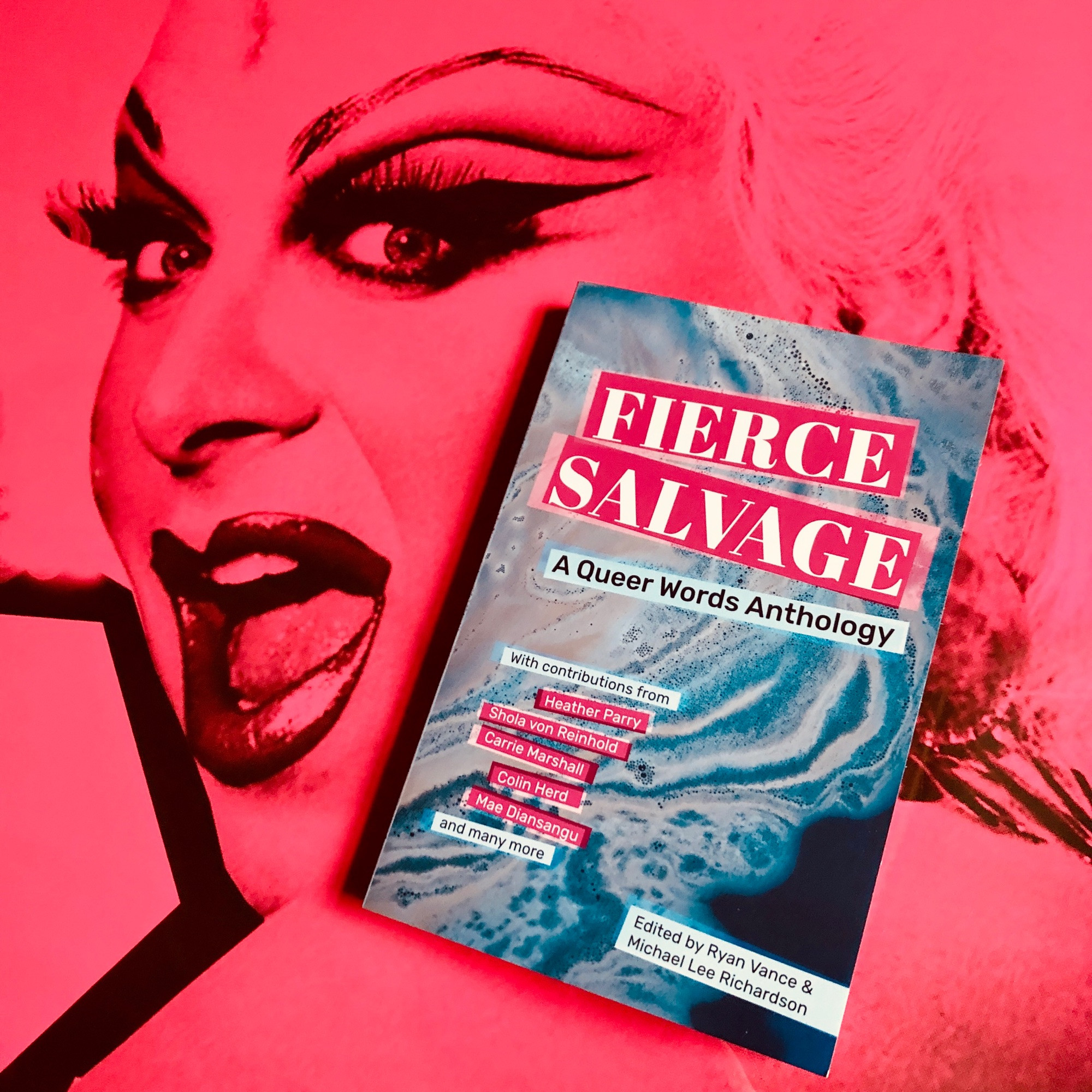
Fierce Salvage: A Queer Words Anthology
Published in February, this anthology of Scottish queer writing is the culmination of two years working with Michael Lee Richardson, 404 Ink and thirty-five brilliant contributors, five of whom were mentees working with five mentors. After we published We Were Always Here back in 2019, we didn’t expect to be putting out another Queer Words Anthology quite so quickly, but the political landscape changed drastically and it didn’t feel right to witness rising intolerance without pushing back however we were able. Many shenanigans and hiccups took place between sending in the funding application and actually getting the book out – minority art is not easy to make in turbulent times! – so I’m incredibly proud it now exists.
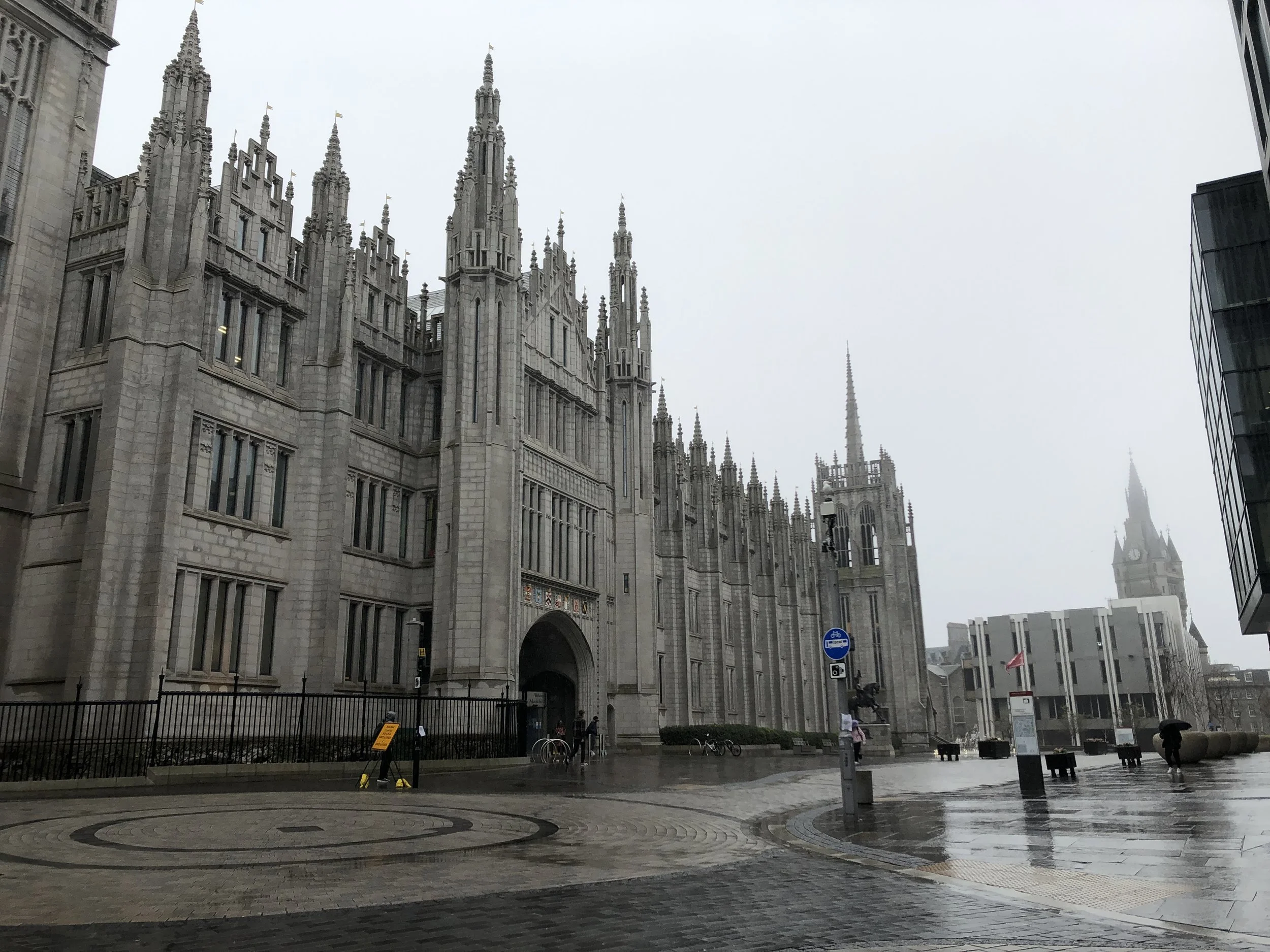
Finally Visited Aberdeen
Despite having lived in Scotland for over 20 years, I had never been to Aberdeen, so when the opportunity arose to hold an event for Fierce Salvage at the Sir Duncan Rice Library, it was the perfect excuse for an overnight stay. The Granite City is meant to glitter in the sun – I wouldn’t know, as it rained non-stop the entire time I was there. Still, the overwhelming greyness of the city was impressive in its own right, and little can prepare you for how hungrily your brain latches onto any speck of colour when the sky is the same non-colour as the land. I particularly enjoyed the Arts Centre’s ceramics exhibition with a wall full of glaze swatches, the Tippling House’s old fashioned paired with well-fried scallops, and a vintage shop near the docks where I bought a comically oversized jumper that I feel awkward wearing in public.
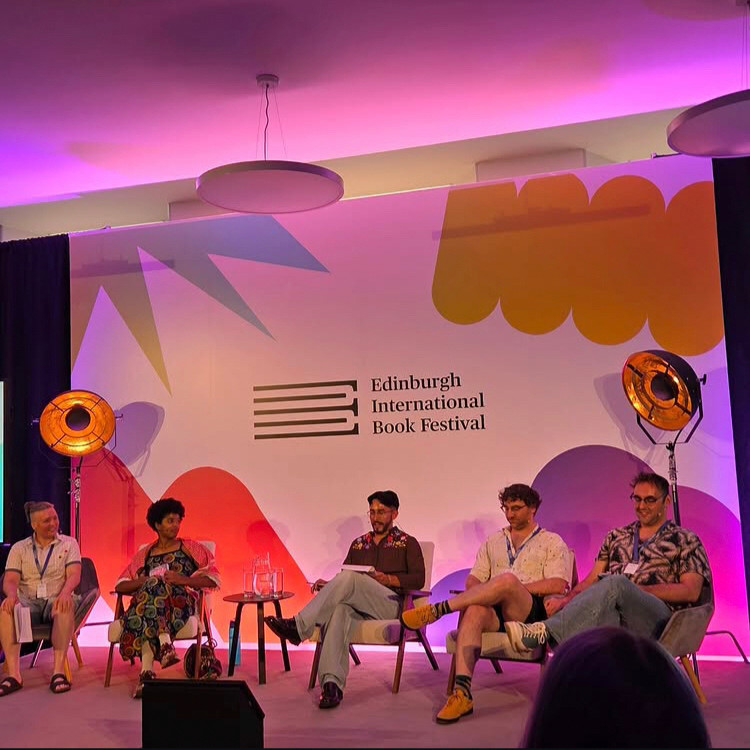
Edinburgh International Book Festival
Another Fierce Salvage-adjacent experience, I got to attend EIBF not as a punter, but as a writer – my first time, hopefully not my last. I used to think I knew what impostor syndrome was, until I picked up my author’s lanyard at the exact moment Nicola Sturgeon’s event ended, and the ex-First Minister sat at the table next to mine with a full entourage, then moved on, and was promptly replaced by Jackie Kay. I was very much out of my depth – so a huge thank you goes out to Andrés N. Ordorica, our event’s host, for making it feel marginally more like I was meant to be backstage.
Denim Cut-offs
A revelation at 39 years old. Who knew showing this much leg could feel so good? (Everyone.) See above for exactly how much leg. (Almost all of it.)
Finished Writing A Novel
My dystopian ghost story is complete. This has been a long time coming. I began in January 2016, before Brexit was even a word, but bailed on the first draft in June when I realised (a) I’d accidentally written a Brexit analogy, and (b) I’d written myself into a corner where the only logical ending was to kill all my characters. Neither revelation was I very fond of. So I came back to the book a year later, deciding to rewrite it entirely, with a more sci-fi edge, specifically a world-destabilising blood plague. And while the shape of the story was largely correct, on a technical and tonal level it was, uhhh, not ready to publish. Had a wee panic, left it aside for a while, and then along came a world-destabilising blood plague. Call me Cassandra. In the wake of COVID-19, the tonal issues just did not feel good at all, and the third full rewrite began. I would not recommend this, as a general approach to writing something large. The ghosts of the first two versions haunted the third, and it took a lot of wrangling and hard conversations with myself to realise how much had to be cut, and then to actually do that cutting. Kill your darlings is fine advice, until you’re faced with a book that’s 85% darlings. A huge thank you then is due to my pal Leckie of Bone Chanter and Wraithlands, who was a first reader of the third draft, and structural editor, and general morale support. It’s now ready to send to agents, which will be the Great Work of 2026. Hopefully the spectres of 2016 lend it a resonance it would otherwise have lacked, had I finished it ten years ago...
Gym Personal Bests
Enough intellectual shite, let’s talk himbo. After (partly) addressing some long-standing biomechanical annoyances in 2024, I returned to the gym in earnest this year, and surprised myself by hitting some personal bests. Don’t get too excited, they’re small-fry as far as proper gym bros go – in fact, looking up stats, I’m squarely hitting the average for beginners my age - but here’s where my big lifts got to on a 5x5 program:
Deadlift: 92kg
Squat: 80kg
Lat pulldown: 37kg
Bench press: 57kg
I can’t overstate how beneficial I find this type of workout for my mental health. Cardio is important and I need to work on that this year, but it doesn’t return me to my body as wholly as weightlifting does. I was looking forward to closing out the year with my deadlift cracking 100kg, but unfortunately I spent the last two months of the year catching every bug going during a particularly rough norovirus/cold/covid/flu season. Still! I got there once, I can hopefully get there again in time for denim cut-offs season.
Crete & Alton Towers
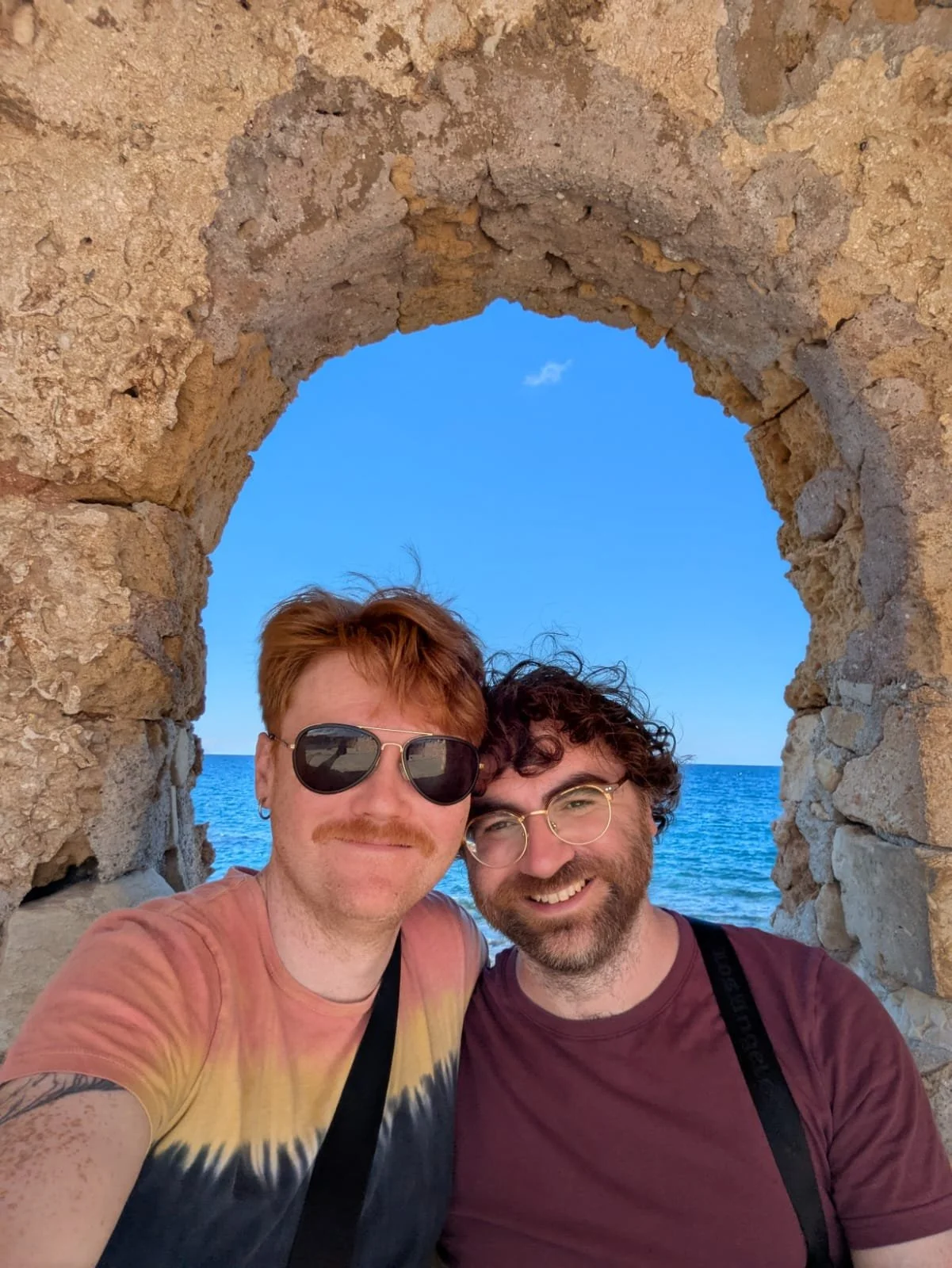
For my partner’s 40th, we went to Crete, and then Alton Towers. We visited the Palace of Knossos, which I had no idea is sort of… not real? Like, it’s mostly an erroneous reconstruction. We took a boat-ride to a nearby bay where I snorkelled while he paddle-boarded. I saw an octopus which was very brave until it wasn’t, and a grotesque nest fire worms. We ate a square of fried cheese the span of my hand, and stuffed vine leaves which were actually good and fresh and flavourful, not at all like the slimy bland canned ones you get in the UK. We stayed in an absolutely gorgeous house in Chania filled with enough antiques to make it feel more like a museum. We snorkelled again, this time off the coast of Elafonisi, among huge shoals of fish. We appreciated the proliferation of pro-Palestine graffiti and awkwardly ignored all the anti-tourist graffiti. Back in the UK, Alton Towers in the early November rain was delightfully quiet, with most queues for rides only 15m, and the smirr on our faces pin-sharp as we plummeted, whooshed and spun around the tracks at 80mph. Financially ruinous, would do again.
Canty Bay Visit
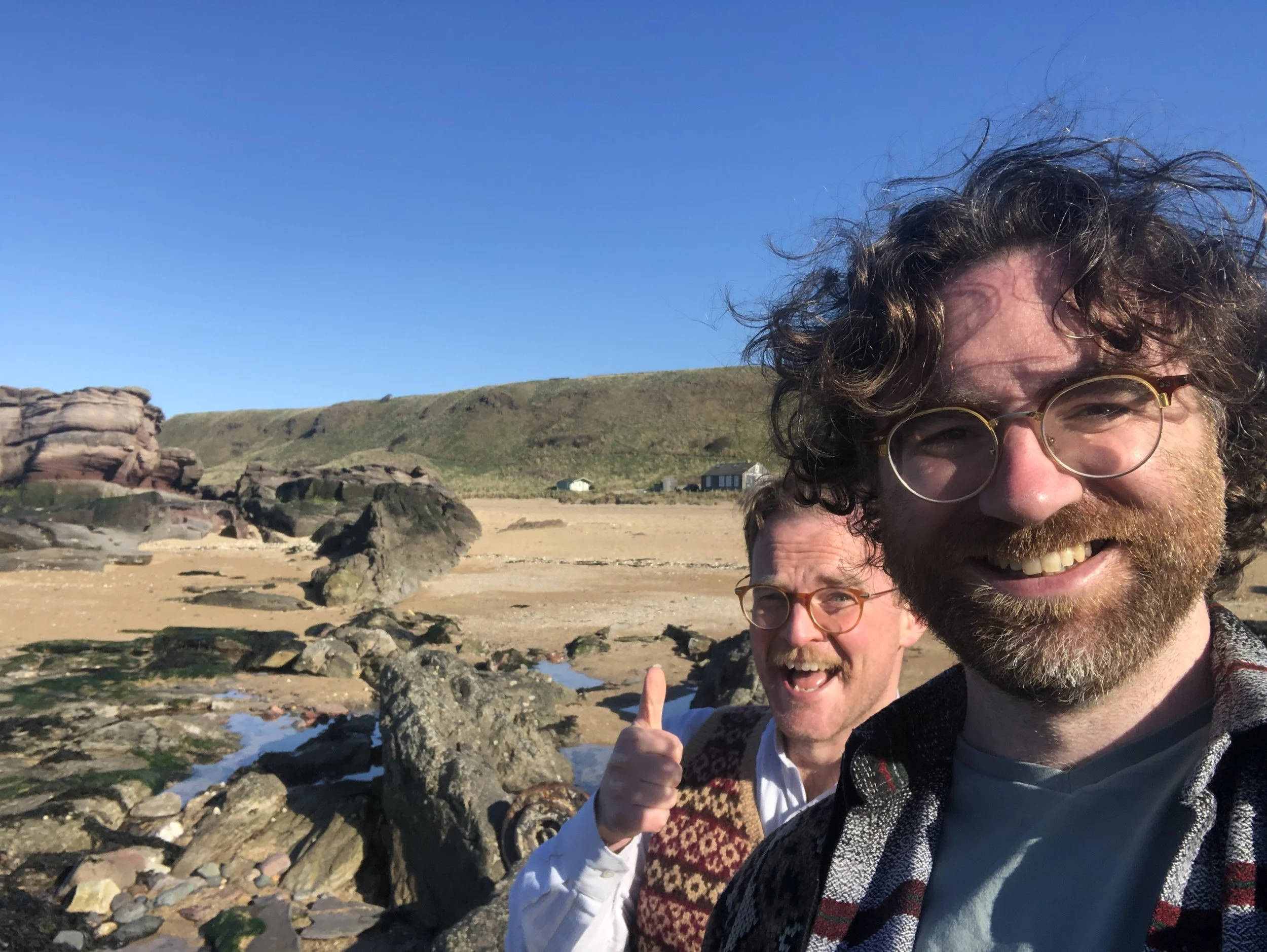
A wee aclove a little way up the coast from North Berwick, a friend with an uncle with a wee shack he rents to family, a couple of nights away from Glasgow watching sunsets and mucking about in rockpools. Heaven.
Kylie at the Hydro
My first-ever stadium pop gig, and also my second-ever, due to a silly mix-up with tickets. First viewing was in the nosebleeds right at the back, with an all-encompassing view of the stadium, which was fascinating. The work that goes into a Kylie-level gig is mind-boggling – afforded a bird’s-eye perspective, little secret tricks reveal themselves, such as sending dancers out in floor length capes to conceal leaf-blowers, to clear the stage of debris from a confetti cannon. Seeing it a second time, from ground level, much closer to the stage, awe-struck at the enormity of the production, felt almost holy. And, of course, the show was wall-to-wall bangers, with a stand-out being a glam-metal reworking of the best Bond theme that never was, Confide in Me.
Rediscovered Collage
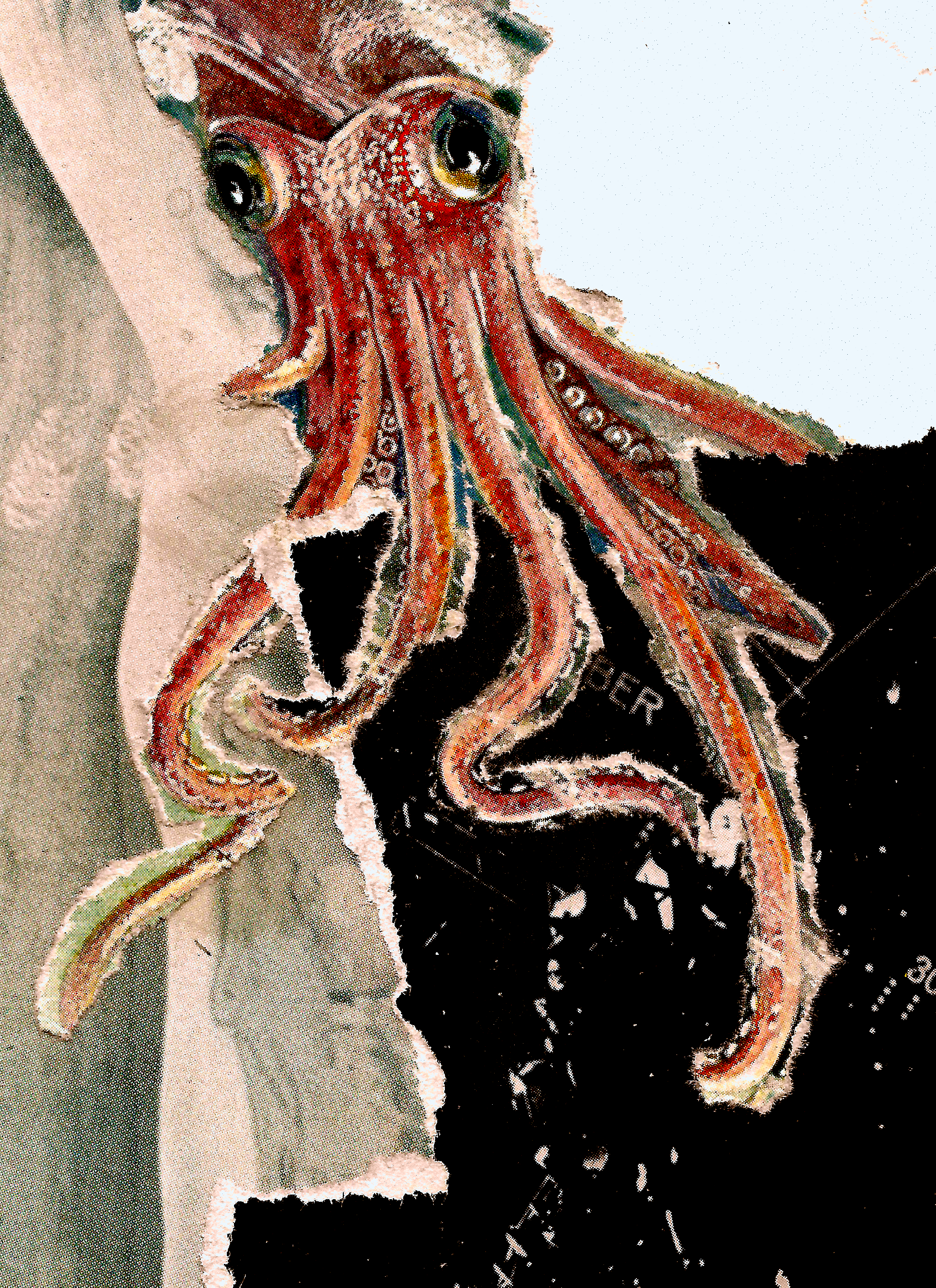
The majority of my design work is corporate, or technical, and it scratches the organisational itch in me that yearns for clarity and structure. But it’s not, well, very fun. And also, design isn’t art, and it might feel like I’m spending my days doing creative work because some design is creative, but the design I do is often quite functional. So on a whim, I had folks round mine for a night of collage, some real low-stakes cutting and pasting, and it felt revelatory? Art is meant to be enjoyable! Who knew? (Everyone.) This feels like a lesson I’ve been continually re-learning across the entirety of my 30s, and I hope my 40s are when I internalise that lesson and have more fun with making any old shite simply because I want to.
Thought Bubble
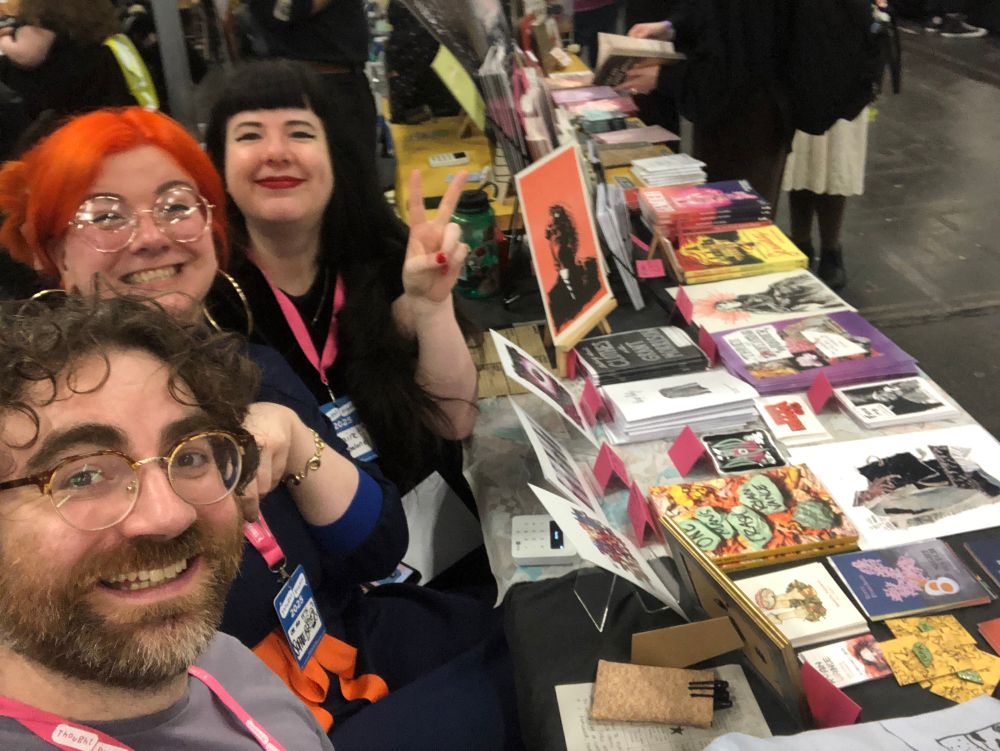
Okay so yes I did say I like making any old shite simply because I want to, but I also like selling art to make money to afford stuff like going to Crete, so: my good friends at Omipalone Press invited me to share their table, after one of their members wasn’t able to make it, at one of the UK’s biggest comic art festivals. (Apologies to Claire and Sophie for a terrible photo of us at our table.) I’d printed a lot of my collage art specifically for the event, none of which sold, because it very much wasn’t that sort of audience. Instead, my Discworld postcards proved quite popular, as did An Honourable Place. But enough about the crass business of sales. Highlights of the weekend were the drive down to Norwich and back, both journeys a raucous singalong to pop legends, meeting in person a whole host of artists and publishers I’d known from The Internet for years and years, and a screening of Hot Frosty, the 2024 Netflix Christmas Movie, which felt like a hallucination at the time and has only become stranger with age.
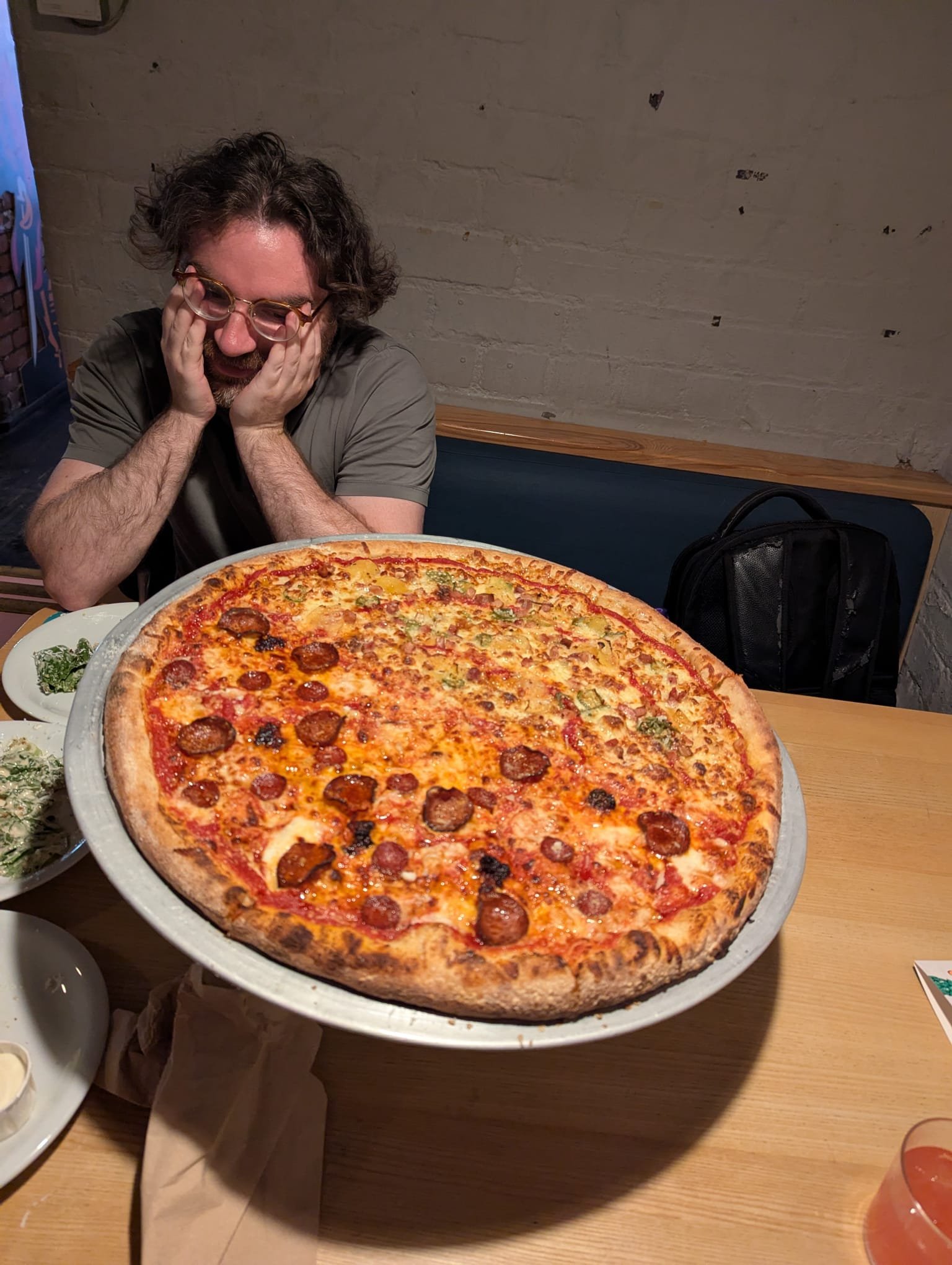
Accidentally ordered a 24in pizza in Manchester
Gastronomically ruinous, would do again.
Best Songs of the Long 2025
End of Year lists typically restrict their remit to the year they come at the end of, which is a sensible approach. This is not that sort of list.
Instead, this is a list of the best songs I encountered for the first time in 2025, with a dozen from this year, two from last year, five spread across 2021 to 2013, and one track dating back to 1968, making it 57 years old, yet still one of the freshest-sounding songs on the list. I tried to limit myself to 20, but it inched up to 24. An extended list for an extended year.
I can’t be arsed figuring out geographically where everyone’s from, but notably, only two are based in Scotland, where I live, but neither of them appear on the Tidal playlist, as their most recent work isn’t on Tidal. Oh, and one band hails from Ireland, where I used to live, but curiously, not the one that sounds Irish. (Put a pin in that, it’ll become relevant later.)
I suppose while we’re doing stats, which are never as precise as they pretend to be, a quarter of the bands/artists aren’t white, a third aren’t men, and only three, as far as these things can be discerned, are queer. Those numbers all seem low compared to my previous end-of-year lists, although I can’t verify that claim, since I opted for a clean slate when I moved from Spotify to Tidal in October, and scrubbed all my playlists. Consider me an unreliable narrator, I often consider it myself. At any rate, I like to think my tastes are more diverse than the stats imply, but the genres I gravitate to tend to be unwelcoming to anyone who falls outside the straight white man hegemony. If I want 2026 to be more inclusive, I’ll have to move outside of my comfort zone.
Also, this list isn’t ranked – I made a playlist on Tidal, and the songs have been arranged so there’s sort of a flow, although that flow can be a bit bumpy, but it’s all quite listenable. I think. Well, mostly. Some of it might be irritating. But I like irritating!
UPDATE: It looks like Tidal doesn’t let you listen to songs unless you have an account with them. So I’ve linked every song to the most accessible, ad-free version I can find online. In most cases, that’s Bandcamp, but some I had to settle for YouTube. Click through to listen while you read, or don’t, I’m not yr mum.
Anyway, headphones on, here we go:
David Longstreth, Dirty Projectors, STARGAZE: Gimme Bread
I love when music makes me feel stupid. Gimme Bread’s opening piano, tentative, fearful, discordant, tickles the underbelly of a music theory I don’t understand – these notes aren’t meant to go together, these chords are wrong, but they also feel right, in a way so unlike how if I were to sit down at a piano and bash a few keys, it would sound like I don’t know how to play a piano, which I don’t. It makes me feel like an idiot and DURR! DURR DURR! DURR DURR! That’s what happens, the intro isn’t even halfway done and the song blasts DURR! DURR! Which is great, as I also love surprises and melodrama and songs that sound like they could be from a musical but, oh hang on, shit, this song has a chase scene in the middle? Fucking hell.
Vampire Weekend, I did not realise your game could go this gentle. If Gimme Bread is a performance artist on a Friday night writhing on a gallery floor, smearing paint on the audience and spitting in their drinks, Connect is the figurative painter in a starchy shirt who every Sunday, weather permitting, takes their easel to the same spot by the pond in the park, to capture on a small canvas how the seasons’ changing light can bend the world, how a sun’s shifting intersection with the upper atmosphere can turn a gaggle of ducks from ornamental sculptures into a cartoon fist-fight, webbed feet and beaks sticking out of a feathered dust cloud.
Ismail Seleit: The Birth of a Hummingbird
I found The Birth of a Hummingbird while looking for a song for an Instagram story of a collage of a hummingbird. I searched for “hummingbird” and chose the first one I liked. Sometimes you don’t have to be oblique, y’know? Anyway, it sounds like a moon inside a cathedral inside a moon.
Leenalchi: Pour and Pour Again
Do not, I repeat, do not pass up the chance to see Leenalchi live. Their combination of stoic tight drums, nimble airy bass, twitchy synths, and vocals oscillating between meditative traditional Korean song and faster-than-light-speed rap, it all adds up to something hypnotic as a cuttlefish. But their presence on stage is something else entirely, the band hanging back, cool as impeccably fashionable cucumbers, while vocalists Kwon Song Hee, An Yi Ho and Chun Hyo Jeong share the stage like a beat-em-up tag-team, pulling back, leaping forward, always in motion, ready to strike, also hypnotic as a cuttlefish. Pour and Pour Again sees them at their breathless best.
My love for Latin American music might be one of the more unexpected aspects of my personality. I mean, I’m a very, very white man, and as I age, I look like I should be more into Mogwai than mambo. But the chokehold Bad Bunny had on the start of my year echoed a summer fifteen-ish years prior, when I could not for the life of me stop listening to Buena Vista Social Club, and also a summer thirty-ish years prior, where on the shore of the River Lagan, a samba band opened for Ocean Colour Scene (no, I don’t know why, either). Somewhere in my parents’ house, there’s a photo of nine-year-old me, dancing at one my first large-scale concert, head thrown back in a scream of laughter, hips and shoulders almost dislocating from my spine, neurons wiring in a new core component of joy. Unforgettable Dance? Aye, you could say that.
My partner, who is much cooler than I am, and more knowledgeable regarding music, put on Afro Harping while we were working from home, back in Spring, maybe late Spring, say May, because it’s not really a mizzly March sort of album, it needs the sun and a little heat. I asked who it was, said I liked it, thought nothing more of it. A few months later, Spotify (boo! hiss! etc) slotted Action Line into my Discovery playlist, and I shared it with him as if I’d been the one to discover it. Quite annoying, I’m sure you’ll agree.
Cheekface were my most-listened to band four years running, between 2021 and 2024. Not so in 2025. The promo around their most recent album stressed how difficult that insane rate of production was while touring during difficult life events, and everyone deserves and needs to set aside the late-capitalism grind and hustle. But man, I hate to say it, the resulting album, Middle Spoon is… mid. Sometimes it sounds like mannequins wearing Cheekface outfits, writing Cheekface songs, getting it sort of right but also incorrect. A guest rap vocal? Two forays into ska? After making a routine of constancy – even repeating the same jokes across multiple tracks – I’m not sure the Cheekface project can expand quite so suddenly, without feeling forced, manipulated, maybe a little panicked. I couldn’t put my finger on why this bugged me, until their late-Summer St Lukes gig, a twin-headline affair with Martha who, given their fanbase in Glasgow, really should have been allowed the actual-headliner slot. After Martha’s set of vim and spontaneity and an impassioned, improvised speech on the intersection of Palestinian solidarity and queer liberation, Cheekface played to a crowd that had visibly thinned, and… went through the motions. Much of the between-song banter was word-for-word identical to when I saw them back in 2023, the audience participation during the songs hadn’t changed, and when they themselves tried to speak to the political moment (which, y’know, fair enough, it’s a tad worse in the USA, or at least bad in a different way), the attempt was couched in so many layers of irony and self-awareness, when it ended on a plea to buy their merch… man, I just soured on them like milk gone bad. It’s not their fault, really – can’t fault an internationally touring band for trying to shift their merch, that stuff’s heavy to lug around. I just think it was the wrong gig, the wrong crowd, the wrong time, to keep doing the exact ame thing that had originally charmed me, and brought them success. I’m being a curmudgeon – most everyone else enjoyed the gig – but I hope they take their own advice, give themselves a few years off the grind and the hustle, and come back refreshed. Anyway, Content Baby still slaps, mostly for the guitar solo that leads into a guitar solo that leads into a guitar solo.
R.Aggs’ blend of folk violin, West African highlife, indie synthpop, experimental percussion, wistful but firm vocals, and (increasingly, lately) a touch of deep south Americana and 80s/90s dance anthems, is so uniquely, wholly their own. Their 2020 cassette, Tape 1, streamable on Bandcamp, contains fragments of all these elements, seeds which have blossomed confidently in their new work, all of which currently exists almost exclusively only as live material. If you’ve seen them live lately, consider yourself blessed.
I was tempted to redux the painter from earlier, for a little weekend jaunt round the neighbourhood junk shops, eating pastries with her girlfriend, but Ankles is already far too saccharine, so I won’t.
Brad Mehldau, Daniel Rossen: Southern Belle
I came to Elliot Smith’s music a year and a bit after his death, during a period when I was fervently converting my teen disdain for pop into an appreciation. Pop seemed, at the time, the swiftest route to accepting my recently, resentfully discovered queerness. Publicly I pretended to fancy Sexy Back-era Timberlake, privately I moped around listening to men who wanted to kill themselves and sometimes succeeded. I think that split somewhat explains why I never really took the time to appreciate the larger picture; how Smith’s quiet anger had pushed back against grunge’s excess, the Loudness War, the theatricality of New York’s emerging cultural dominance of the early 00s indie-rock post-punk scene. I was mostly just listening for the doomer vibes. This cover has an overabundance of doomer vibes, Smith’s depression traded in for Rossen’s anxiety; I’m still here for it.
If this playlist was ranked, this would maybe be a bit lower in the rankings, but it’s still a top twenty-and-change, so, y’know. Good going. I’m a sucker for dreamy checked-out vocals, syncopated stabby guitars and delayed riffs which sync up at the end of a wordless chorus. Trust and believe, I’ll be repeating “we got the good simulation this time” to myself after every halfway-good happening in 2026. But the playlist isn’t ranked, so instead here officially begins a grungy interlude. Skip forward to Jazz on the Autobahn if that’s not your thing.
Blondshell: Docket (feat. Bully)
They just do not make them like this any more, do they? Well, obviously Blondshell does, and so does Bully, in fact a lot of alt-rock sounds like this, but you know what I mean: the lyrics hurt. Every line a regret, a remonstrance, a 90s teen slasher fishing hook to the guts – you’re sort of not allowed to hate yourself this hard any more, which as a card-carrying hater, I appreciate. Also, for me, sonically, Blondshell fills a hole PWR BTTM were on track to fill nearly a decade ago, only without all the allegations. Basically, a resurgence of the sparklier, more melodious end of grunge, a bit Hole, a bit Garbage, but also a bit Tori Amos and Veruca Salt. The sort of song that plays while Buffy and Spike slowdance in the Bronze - and indeed it scored high in a Music League round on that exact theme, so thank you for that, Blondshell.
Mendicant is a completely bog-standard mid-tempo post-punk ditty about sacking off all your responsibilities, right up until the 26-second mark, and then something happens that honestly I still don’t have words for even though I’ve rinsed this a hundred times and more since it released in May, but here goes anyway: I’m from Northern Ireland, which is Ireland but it isn’t, but I’ve lived longer overall in Scotland, which mostly doesn’t want to be British but nevertheless is, which, look, obviously there’s baggage, we do not have time to unpack it all here, but the relevant bit is this: I cannot with a straight face identify as Irish, Northern Irish, Scottish or British, despite partly being all of them, in one way or another, but Irish is ultimately the identity in which I feel most a pretender, and yet 26 seconds into Medicant, when those uilleann pipes arrive, sort of muddy and tired in the mix, like they’ve travelled a fair distance over a muddy field oh, oh, I want to cry with a homesickness completely alien to me, completely alien, maybe because of all the identity stuff, I simply do not have the capacity to miss a place, a time, I do not do nostalgia, and I do not consider myself to have a homeland, and low-key find any kind of nationalism sort of embarrassing at best, nefarious at worst, and yet here they come over the fields again and oh, Danny boy, the pipes, the pipes are calling!
The Felice Brothers: Jazz on the Autobahn
You will prise my soft-spot for Americana-tinged purple-prosed talky-singy pre-apocalyptic hope-core drive-time road-trip optimistic-dirge cod-philosophical honky-tonk from my cold-dead hands.
Sanam played a beautiful, thundering, mesmerising gig to a packed-out Flying Duck at the start of December, and if they’d played six months earlier, and I’d gotten to know them a little more, I’d have more to say, but I’m still very much relaxing into their mix of traditional Lebanese folk, post-punk and droning noise. I think Bell is a bit of an outlier for them – jazzy, scrunchy, angry, impatient – but I’ll need to listen more in 2026 to be sure.
Metronomic delirious blown-out distorted shouty Irish guitar rock might not be the most obvious soundtrack for a night of collage primarily featuring hummingbirds – collage being an art form growing tweer by the minute - but perhaps a suitable accompaniment to a deranged freelancer designer crosslegged on the carpet tearing up National Geographics wondering how the hell he’s going to afford to pay bills come the New Year and thinking fuck, maybe it’ll be collage, maybe he’ll be the next great collage artist, move over Dada, it’s time for no what the fuck are you thinking fuck shit fuck fuck shit collage are you serious you can’t make a living off collage fuck shit the song’s ended put it on repeat shout fuck shit collage fuck.
Les Savy Fav: Legendary Tippers
LSF played a top-ten-gigs-of-my-life-of-all-time-and-perhaps-top-ten-gig-anywhere-ever at Drygate, a soulless cavern of a venue that would obviously rather be a full-time sports bar, if only it wasn’t so dependent on us aging hipsters buying their craft beer. Unpredicable frontman Tim Harrington spent the entirety of the show roaming the crowd, forcing us to hold his very long, very beer-sticky, very floor-grotty mic cable aloft, as if he was a diver and we were reeling out his oxygen. He dragged a table into the crowd to make a satellite stage, he bought a pint halfway through a song then threw it over his shoulder, he stripped down to his Y-fronts and did a running slide on the concrete floor, he dressed up as the pope, he accepted a gift of a bottle of port and lurched from person to person pouring it into their mouths with very little precision. That he, and the rest of us, survived the gig intact, is a miracle.
I’ve been a fan of Preoccupations from way back, when they were still called Viet Cong, a name they changed for obvious reasons. From the 2012 album of the same name, I’ll be listening to Bunker Buster until I die, maybe even as I die, those opening guitar riffs digging into the flesh of life like a biting dog, roughly shaking the thing side to side, a refusal to let go, to drop it. So I was ecstatic to finally see them play live earlier this year - but regrettably at Room 2, in my opinion Glasgow’s worst live music venue. The stage, bordered by stairs leading either to the bar or the street, occupies what clearly used to be half a relatively functional sunken dancefloor, now hedged in on the opposite side by the sound desk. As a result, the only spot from which to watch the band is constantly interrupted by people arriving, leaving, going to the bar, which, elevated but perpendicular to the stage, encourages a lot of chatter to clutter the soundspace, something which the hapless sound-techs don’t know how to accommodate or negate. All three times I’ve attended a gig, the sound desk seemed to be manned by someone grabbed off the street, men with the whites showing all round their eyes, pushing buttons in a panic like they’re in an I Love Lucy skit. Add to this, for the Preoccupations gig, two heavyset men who decided the already-too-small dancefloor was the perfect place to start a mosh pit, population: them, pushing everyone else up the bordering stairs, lest we take an elbow to the face, and, well, it could have been one of my worst gigs of the year. But it wasn’t! Preoccupations were that good! Listen, anyone who’s seen me shoot daggers at talkers on the dancefloor knows it takes something very special for me to waive breaches of gig etiquette, and Preoccupations delivered. With a broad mix of songs from all six albums, not much weight was given to their newest album, Ill at Ease, their smoothest and jangliest and most new-wave to date. And as much as I adored Bunker Buster blasting the room at close range (proximity being the only thing Room 2 has going for it), I’d love to experience a set of only their latter material, with a less nostalgic crowd, afforded more space, and license, to actually dance. Anyway, the gig was stellar, and album opener Focus, one of the more polished and propulsive tracks, was an easy highlight. Not to mention, on the recording, I’m 90% sure that’s Cindy Wilson guesting on the chorus, or at least a Cindy Wilson-soundalike, which if this list was ranked, which remember it isn’t, would be a short-cut to placing in my top 5 of any year.
Despite a friend describing Clipping as Musicals for Boys Who Don’t Let Themselves Like Musicals - a read so savage, it risked obliterating not just my enjoyment of Clipping, but also my fondness for songs that sound like they aren’t from a musical, and then my sense of self, and then also most of Neo Tokyo – despite that, I’m still besotted with this strobe-quick slice of end-of-days cyberpunk.
Pink Pound’s been described in the past as “yassified New Order”, but lately they’re pushing towards something more nebulous, digging deeper into where the overlap of pop, post-punk and new-wave cast irregular shadows. The Acts EP toys with masculinity, repetition, desire, decoration, restraint – my personal favourite, Play Pretend, lays down a mechanical push and suck of drum machine and synth and samples, as Pink Pound’s rich vocals flip from coy to generous to scornful to sultry, sharing a good dose of DNA with George Michael’s Freeek! High praise? Yes. Am I biased? Yes. But am I also correct? Yes.
Jacob Collier, Kimbra, Tank and the Bangas: In My Bones
When Jacob Collier’s extremely tricksy multiphonic cover of Stevie Wonder’s Don’t You Worry ‘Bout a Thing went viral in 2010 - and remember, I love music that makes me feel stupid, not to mention the cover mutates into a heavy salsa halfway through - I basically had no defences against it, despite it being, and remaining, extremely cringe. And now here he is with Kimbra, one of thee most slept on pop geniuses of our time! As well as Tank and the Bangas, who, well, I’m not completely in love with their contribution here, but it would be churlish to dock points from a song explicitly built to be overstuffed, for being overstuffed. And boy is it overstuffed! Every note devised by man gets a cameo, like the last episode of a beloved sitcom where everyone says their catchphrase one last time.
Formal Speedware: Wait (Hatchet Gets a New Hide)
Yeah, DEVO, Talking Heads, Brian Eno, we can all hear it, but look - if you don’t appreciate Beck Clewlow’s gleefully pained HHhheeeuunnnGhn! at precisely 2:31, I don’t know what to tell you.
Goldfrapp: Slide In (DFA Remix)
You would think, being a DFA simp, and a once-Goldfrapp stan, I’d have known about this remix long before now. You would be wrong. I make no understatement when I say, discovering this percussive gem twenty – TWENTY!!! I perish – years late, single-handedly salvaged some of the grubbier days of 2025. When I finished my book – that is, the complete first draft of the third version of my book containing the third draft of the first third, the second draft of the second third, and the first-and-a-half draft of the final third (look, just… just let it… writing a book is hard, okay?) – I put this on repeat and danced in the living room until the windows fogged up and had to be squeegied dry.
tUnE-YaRdS: How Big is The Rainbow?
Back in 2011, tUnE-YaRdS’ W H O K I L L (if you don’t format these things correctly you’re a journalistic coward) pulled me out of depression. Probably shouldn’t have cancelled my second appointment with a therapist one (1) calendar day after hearing Bizness, because I went right back to being depressed come 2012, but hey, you live and you learn. Better Dreaming is probably my favourite of their albums since W H O K I L L, overall less self-conscious of its musical influences, more optimistic with its politics, and finding comfort, rather than uneasy anxiety, where they intersect. Though they’ve yet to best Heart Attack from 2018’s I Can Feel You Creep Into My Private Life, How Big is The Rainbow? comes very, very close. Was it corny when, during their November gig, Merrill Garbus got the audience to harmonise on Rainbow’s chorus? Yeah, it was! Is it, to quote The English Teacher’s Malcolm, a bit born-this-way gay, a bit I’m-with-her queer? You know, like, love-everyone-regardless-of-whether-they-love-you preachy? Well, yes. But that’s tUnE-YaRdS’ whole thing! Singing about how hate comes from within us all, even when we’re trying to love, and in fact that’s when hate becomes its most destructive form, and while hate might come from within, it’s condoned from without, stoked and encouraged by forces larger than any one of us individually, and it takes all the collective, communal will in the world not to let that become normal or normalised, or you yourself will rot from the inside, so you might as well sing it all out at the top of your lungs, and it doesn’t even have to always sound good when you do, sometimes anger and disappointment sound weird and wrong, but if you sing enough wrong notes together, they end up sounding right - that’s their whole deal! That calculated naivety and wonder – like pulling three tarot Fools in a row – that’s what pulled me out of depression in 2011, and made the gig, likely my last of the year, so transcendent. Sure, I love music that makes me feel stupid. But I love music more when it makes me feel loved.
Reads of 2025
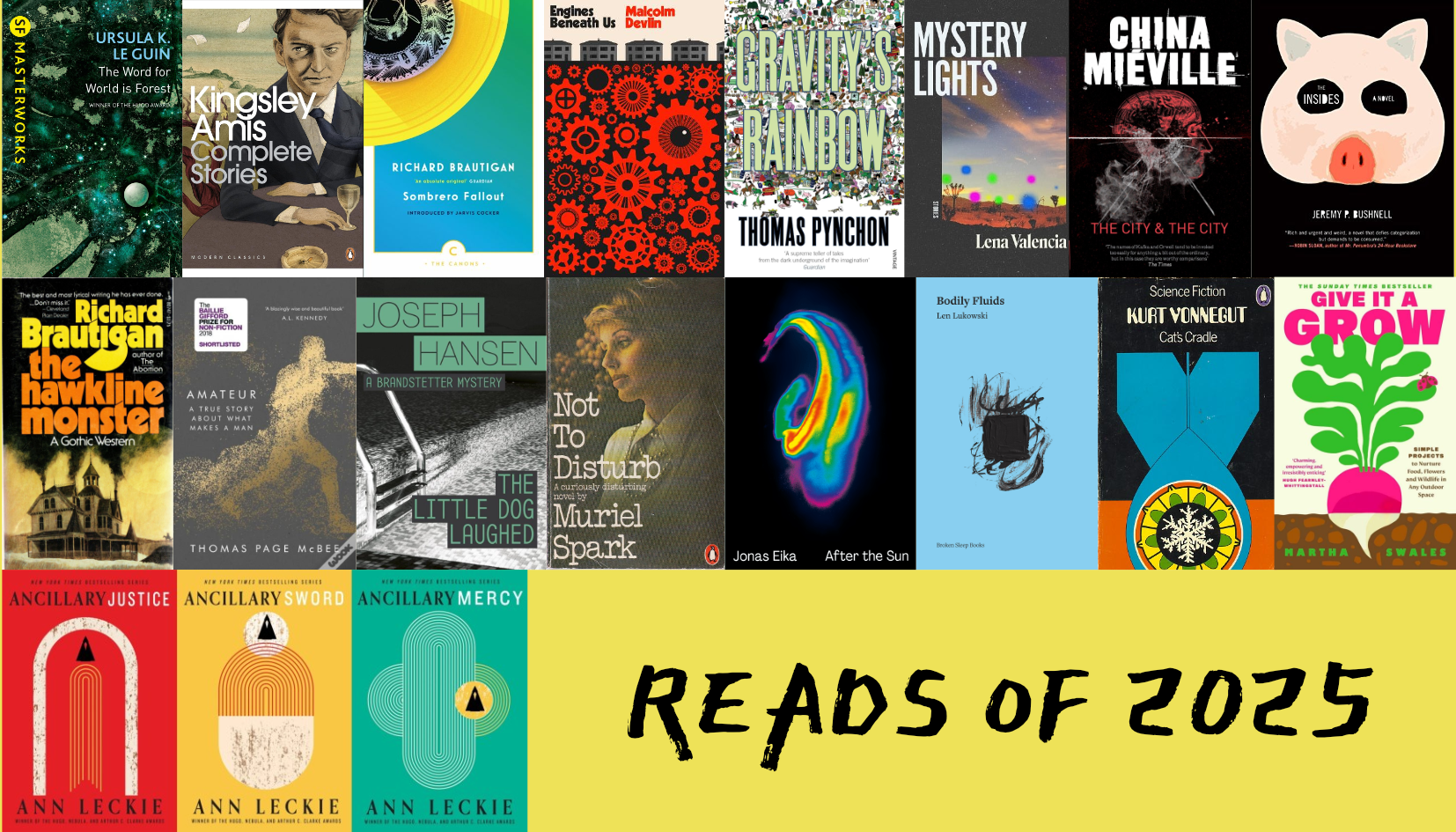
Here are all the books I read in 2025 – I think. I didn’t keep a list throughout the year, so there might be some I’ve forgotten. I’ve not included magazines, such as Gutter, which being on the editorial team I read as part of the production process, or Extra Teeth, which this year came back from a brief hiatus. Could I have read more? Yes. Should I have read more? Shut up.
But lads, it’s not been a good year for reading. That’s not 2025’s fault, but more a result of me forcing myself to get through my to-be-read pile, only realising a little late into the endeavour that it’s mostly books I don’t want to read.
The list is loosely ranked in descending appreciation. If you’re in the habit of only reading recommendations and positive reviews, I won’t hold it against you if you bail halfway. While I enjoy chewing on my dislikes as much as I enjoy analysing my likes, there’ll be a happy charity shop or two come January, I’ll tell you that much.
That said: the good shit does come first! In fact, the best book I read this year was published this year, which doesn’t often happen, as the old classics and award darlings from yesteryears often make for stiff competition. Yet, even Le Guin and Spark couldn’t nab the top spot!
So, with no further rambling, here’s seven books I loved, six I wasn’t too sure about, and six I did not care for at all.
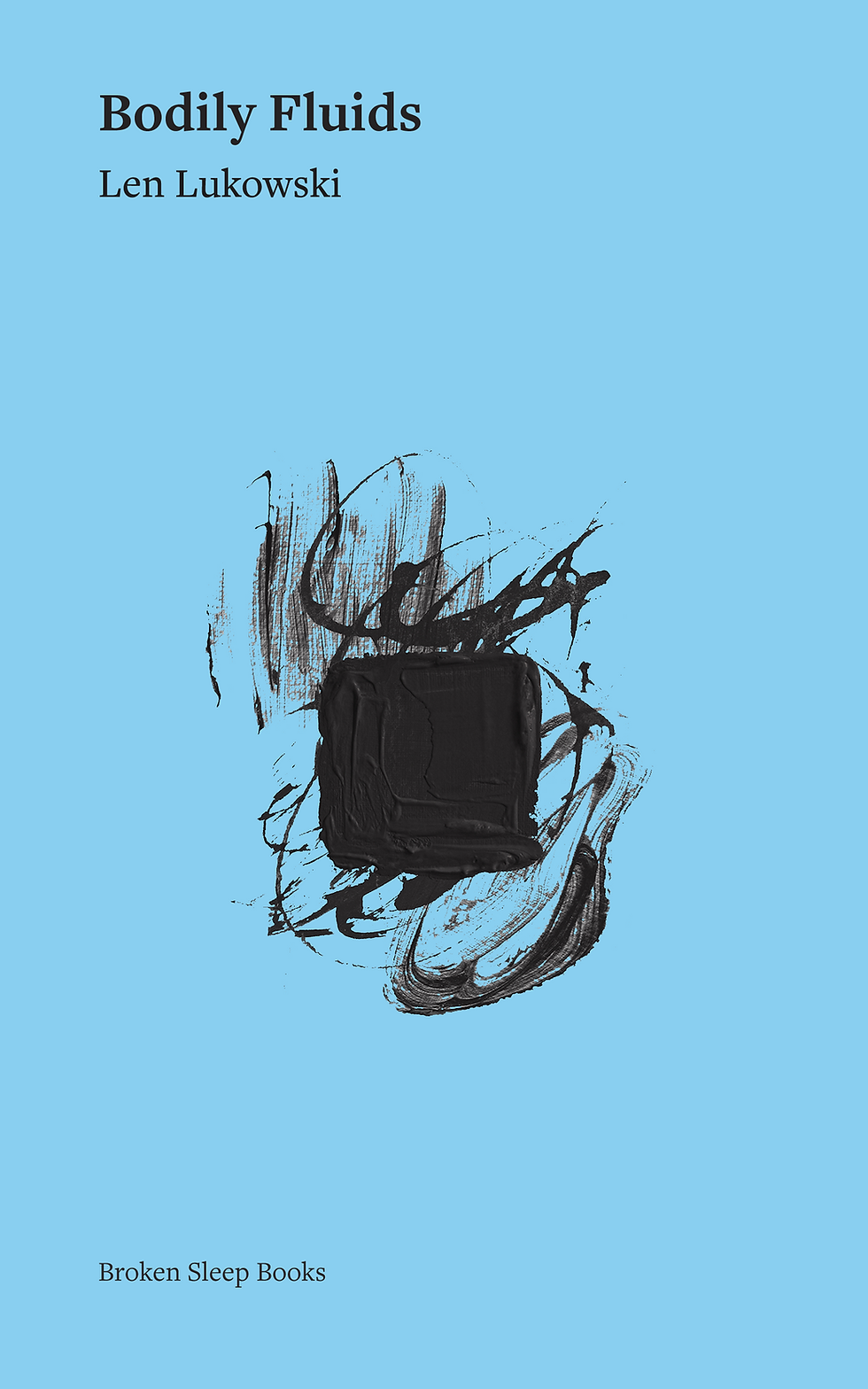
Len Lukowski
Bodily Fluids
My book of the year! Poetry, which is surprising for me, but I gorged on this during an express train ride to Edinburgh, then returned to and digested it more fully on the dreaded long train back to Glasgow, and fell in love with it. Gutter asked the team to recommend their books of the year and, not realising they only wanted two or three lines, I wrote a full review, which I’ll copy/paste… now:
These starkly personal poems expose wounds not yet healed - soured relationships, unresolved trauma, suicidal thoughts - with barely a preamble. True to life, doom lifts and descends at a moment’s notice, jaded hurt twisting into cocky assurance, lust and friendship breaking through dissociation. Bodily Fluids is a game in which Lukowski tries to knock the reader off-balance with the softest of touches - and often succeeds.
Comedic flashes of nature - human or otherwise - are routinely shot through with desire, convenience, lowered expectations. In 'Pandas', the titular bears refuse to procreate until humanity gets its shit together, while 'Sea Turtles' provides an ambiguous source of hope, reptilian instinct pitted against man's selfishness. Across 16 short entries of things that aren't dogs but could be, one list poem ricochets between the park and the club, the soft comfort of plushies and the black leather of puppy play.
Everything feels of an even importance, so while at first glance Lukowski seems to imply it’s always worth trying to laugh (and fuck) the pain away, moments of quiet solitude make space for the pain all the same. In one particularly touching poem, returning to his Sixth Form common room, Lukowski is able to see through the haze of youthful nostalgia to the tacky plastic reality, closing on a confession all too familiar to many a queer reader: "I still fear the sound of laughter."
Yet, despite how shame looms over this collection, there's a strong sense of play, both for its own sake - such as in 'Blue Room with Dildo', a still life of self-pleasure - and as retaliation - such as in 'Ode to Vega', where Lukowski comes on strong to Street Fighter II's omnisexual assassin. Sex and sport make for occasional bedfellows - 'Fugue After the Gym' finds delight in reparative self-harm, while opener 'Olympian' weaves a fantastic orgy of memory, release and, yes, fucking, on a global stage.
With secret after secret given away like its nothing, Bodily Fluids elevates the overshare into a dance of permissions and confrontations, impossible to resist.
Ursula K Le Guin
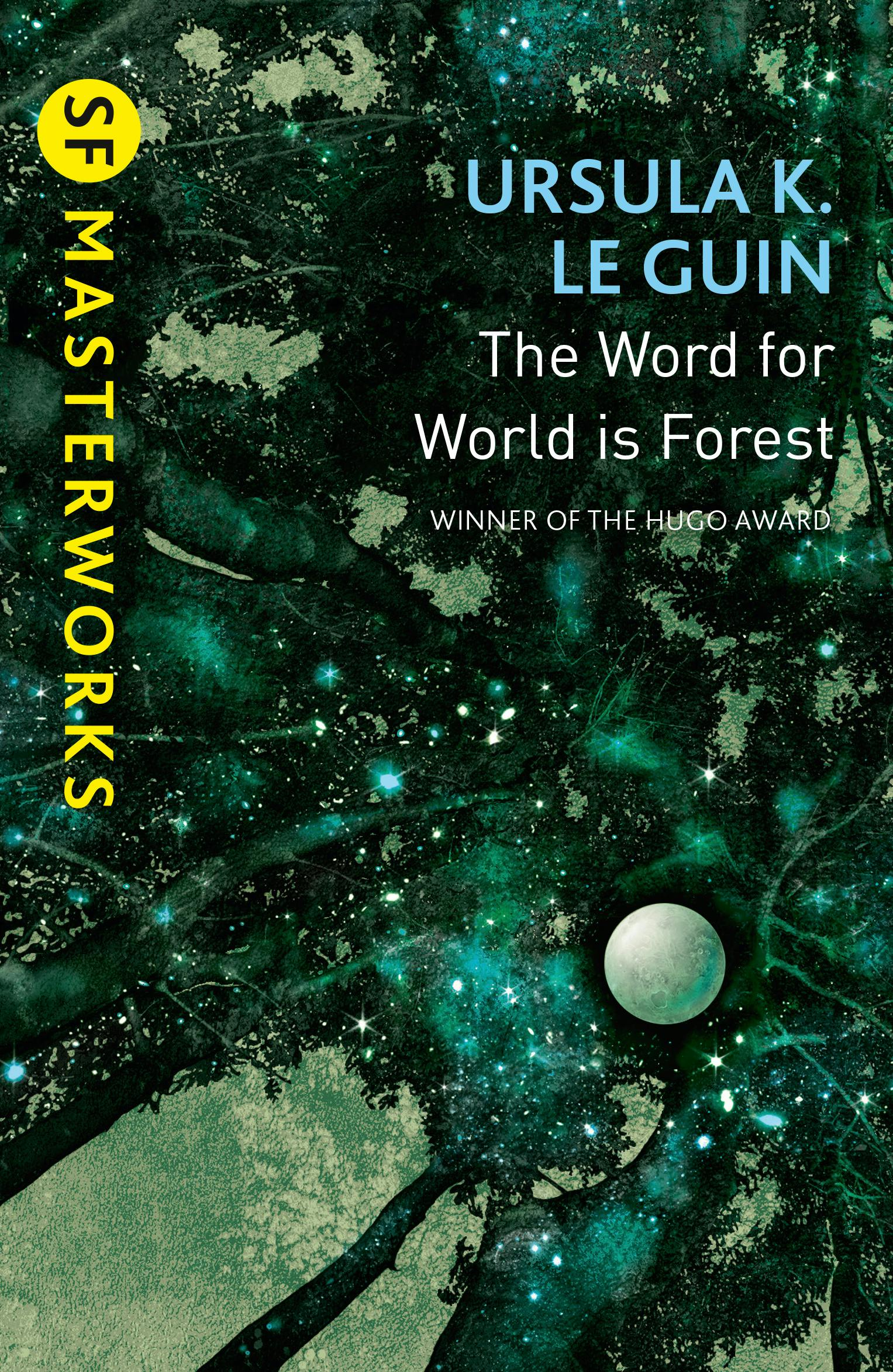
The Word for World Is Forest
I knew going into TWFWIF, it received less-favourable reviews than most of Le Guin’s other work – I think it says so in the introduction to my copy, with a cover so hideously obvious (not the Masterworks pictured here, uncommonly pretty), you can see where the reviews might’ve been coming from. Compared to her masterpieces, they claim, it’s too on-the-nose, too polemic, too obviously about the thing it’s about; that thing being the Vietnam war.
In TWFWIF, humans have taken control of a planet with ample supplies of valuable wood, and a sentient alien race who are so unfamiliar with violence, they possessed no defences against Humanity’s colonial impulses. The evil characters are too evil, the good characters too good, or so says the criticism. But there’s not much wiggle-room, imo, in a story about colonialism introducing a pacifist community to incomprehensible violence and, in doing so, poisoning their society for the rest of time. In fact, I think there’s power in being able to easily declare that war is wrong, rape is wrong, slavery is wrong, colonialism is wrong, and if peaceful resistance is forbidden, forceful resistance will have to suffice – end of discussion.
Also, I think there is nuance here, if you’re willing to first and foremost empathise with the Athsheans rather than the Earthlings. The nuance is there in the delightful representations of Athshean culture, such as conflict resolution through singing or passive poses. The nuance is there in the idea of violence as a physical sickness, endlessly endurable as an action inflicted upon you, but once internalised, as an action you can personally commit, it interrupts a natural, even biological cycle necessary to a community’s holistic wellbeing.
That these nuances are by the book’s opening already all but erased, should, I feel, prompt a terrifying question - what nuances of our own culture have we lost, do we not realise we’ve lost, will we never reclaim again? Exactly how have we poisoned ourselves?
Muriel Spark
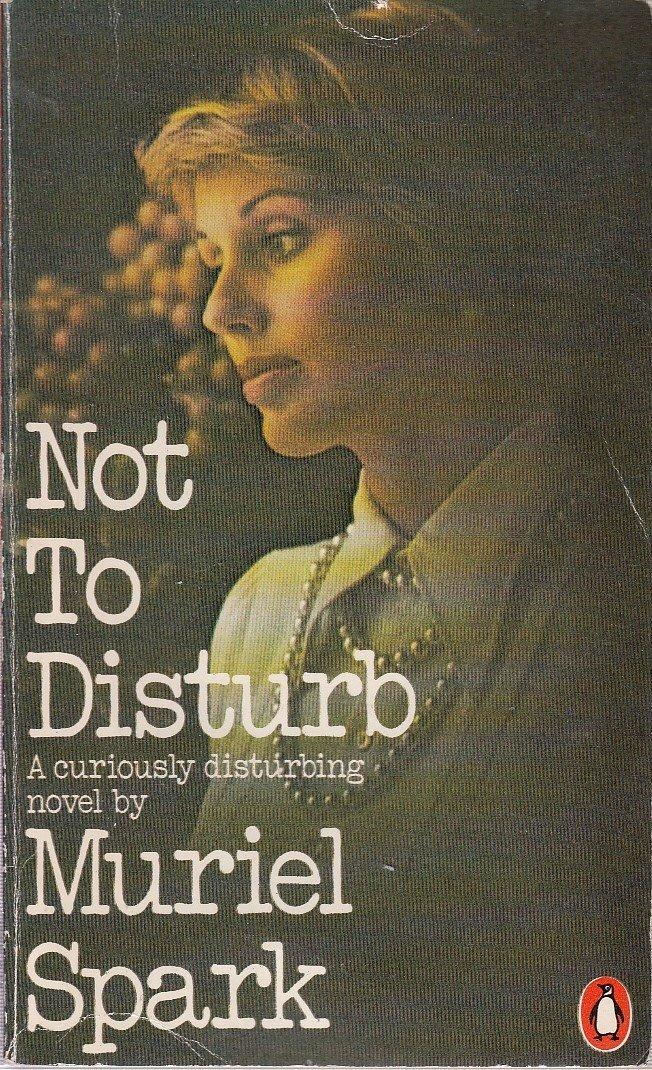
Not to Disturb
In a curious pattern of me enjoying literary legends’ flop eras, Wikipedia says this was also a mixed bag for Spark, reviews landing between annoyed and indifferent, but I loved it. A short nasty farce where the servants of a baron machinate in preparation for a triple homicide that has yet to occur inside a locked drawing room. Perhaps being largely unfamiliar with the genres it lampoons – manor murder mysteries, upstairs/downstairs melodramas – allowed Spark’s trademark restrained mysticism to shine. The servants share an uncanny precognitive hive-mind, or at the very least a spiritual link to their employers’ mortal predestination, obsessing over when ithe murder will happen, never once contemplating that it might not come to pass. Another of Spark’s favourite devices – repeated aphorisms – goes into overdrive, becoming more and more like a chant or spell, instructions delivered to the servants by a telephone that becomes increasingly demonic. There is, of course, also a madwoman in the attic, a pregnancy without an obvious father, an interruption by a trio of punks trying to shake down the baron for all he’s worth, a secret safe, an even more secret hiding space, and an affair that might be incestuous. Overstuffed? Yes! But all the better for it.
Jeremy P Bushnell
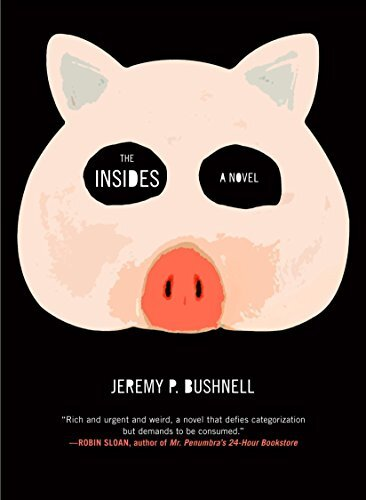
The Insides
In the words of Gordon Ramsay: Finally, some good fucking food!
Ollie Krueger’s an ex-magician, her past littered with mistakes, now earning an honest living prepping meat for a high-end New York restaurant. There, she encounters a knife that can cut reality, putting her on a collision course with a morally-agnostic psychic and a white-supremacist ex-marine who want to slice history into a more eugenicsy shape.
A freefall almost from the word go, the heroes possess a flailing kind of panache, the villains a rudderles cool, and it’s genuinely thrilling to watch both teams styling out the freefall, daring the other to hit the ground first. And yet, it sat on my to-be-read pile since 2016, its year of publication, because at the time I was on a sErIoUs LiTeRaTuRe kick, and worried it might be an already dated relic of le epic bacon era.
Don’t worry, I’ve since got over myself and also, it’s very much not that – there’s an art-punk sensibility, a commitment to joy as rebellion, and a genuine respect of sacrifice, which adds grit and heft to the madcap antics. And to be honest, I’m not certain I had the necessary nous to appreciate why this book is so fun, in 2016: even though it’s quite silly, it takes itself seriously. Behind the interdimensional slugs and the pig masks, the stakes are real: every minute of every day, authoritarian maniacs seek to convert our grief for a better world into crushing hopelessness, and you cannot let that happen. Only one course of action is ever given the time of day: you have to cut Nazi bullshit out of your life, before it cuts you and everyone you love out of existence.
Lena Valencia
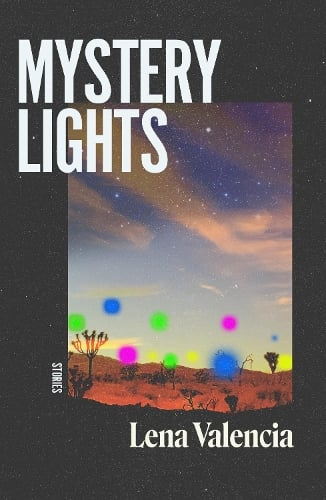
Mystery Lights
I adored this collection – most of the stories dance around an emptiness where there should be meaning. This has earned it a low-ish three star rating on Goodreads, with most of its detractors wanting something more declarative. Unfairly, I think.
The first story plays this ambiguity well, a familiar tale with no twist at the end: a man in a pick-up truck saves a woman hiking in the desert from a pack of dogs – but is he as dangerous as the wild animals? Probably! Yet nothing comes of it. The man doesn’t give much reason for her to fear him, we know she’s right not to trust him, but validation of those fears never arrives: a feedback loop of threat, with no clear beginning or centre.
Though some stories move to university campuses or city offices, this haunting void of consequence works best in the desert setting, which makes frequent appearances. My favourite in the collection concerns a mean-spirited painter and her lover’s lonely daughter, each unbeknownst to the other communing with the same glowing orb in the wilderness. It’s never made clear what they gain from this entity, only that they’re not getting it from each other, and maybe they shouldn’t want it from each other, and anyway, they wouldn’t be able to give it.
Sometimes, these stories say, emptiness can be substance – and filling the emptiness with answers would miss the point entirely.
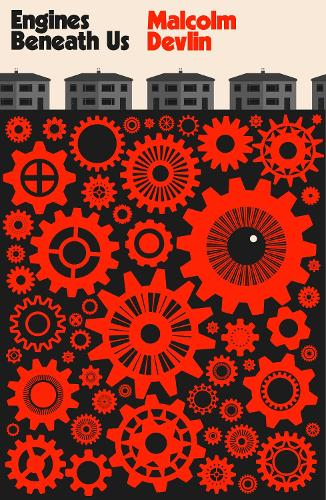
Malcolm Devlin
Engines Beneath Us
A murky horror novella that doesn’t give much away, as all the best murky horror novellas don’t. Devlin transplants British folk horror from the countryside to the schemes, and in stripping the breezy Tory-coded rural aesthetic from the genre, choosing instead a dark reflection of a New Labour-esque housing project, the atmosphere becomes punishingly bleak.
The Crescent is a strip of company accommodation for employees of The Works, a mysterious but essential service to the city. They’re taken care of, thanks to the healing powers of a secretion dredged up from their basements – but only for as long as they agree to never leave, and trade their labour as payment for their health, and subject themselves to a panopticon of curtain twitching. When an outsider arrives, everything taken for granted comes into question.
The Crescent works like a cult, but it’s not a cult – it’s a heightened representation of a working class experience in an industrial satellite town, dedicated to maintaining a lopsided pact nobody can remember making. The horror doesn’t come from finding out the dark truth of what makes The Works work, but rather that the truth doesn’t matter. All that’s left is a grim acceptance of living to work and working to live; stepping outside of that pact will cost you everything.
A short dirty sharp book, like broken glass stirred into a muddy garden.
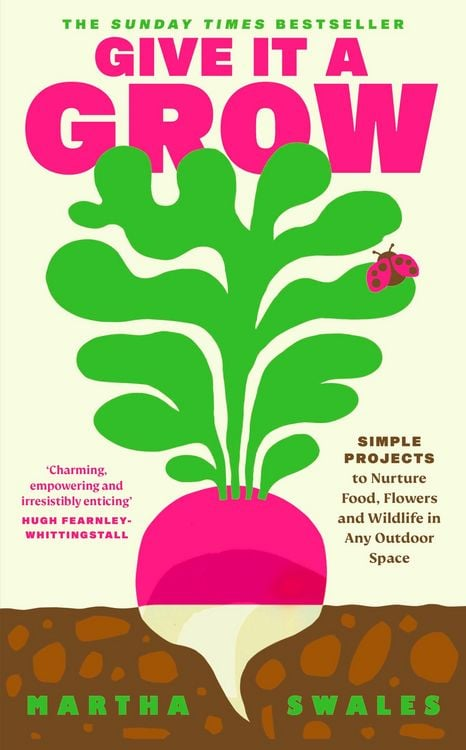
Martha Swales
Give It a Grow
Speaking of gardens! An extremely chill primer on gardening. Swales essentially says: if you’re a beginner, the variables of biology are far beyond what any one book can cover, some things you plant will die, don’t sweat it, have a fuckabout. Which is liberating, for sure.
A majority of the planting advice concerns growing fruit and vegetables on the scale of an allotment in a rural-ish English back yard. Which makes most of it irrelevant to our sliver of Ibrox tenement scrub which is less likely to come under siege from hedgehogs and slugs, and more likely to be drowned by footie hooligans wanting somewhere to piss out nine pints of Tennants. I’d love to attempt her mini-pond project – her viral tadpole video being what inspired my partner to buy this for me – but I fear our upstairs neighbour’s window-cleaner would come a cropper if we dug a moat where he lodges his ladder.
Similarly, all the emotional benefits covered in the book involve being out in your garden, enjoying it up close, but I would look an absolute lunatic lounging in a deck chair among my (as yet, unblooming) wildflower meadow, in full view of one of Glasgow’s busiest streets, not to mention dozens of curtain-twitching neighbours. So: an aspirational read, rather than instructional.
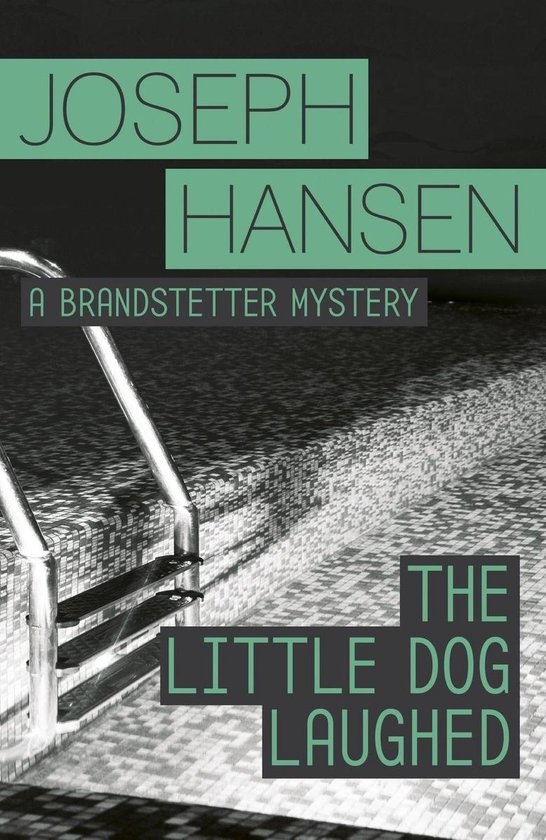
Joseph Hansen
The Little Dog Laughed
If you’ve spoken to me about crime fiction any time in the last ten years, I’ve probably sung the praises of Hansen’s Brandstetter Mysteries. I found an incomplete early-2000s No Exit Press collection in a book fair. The most current covers either feature a Scandi-noir minimalism applied to sun-blasted LA that entirely sidesteps the books’ queerness (pictured above), or bright retro vector art that does put queerness on the page but, considering the 70s-90s period which the series covers, to my eye ends up looking a bit too 60s Hitchcockian. Perhaps I’m biased, but I think No Exit Press nailed it with their high contrast, blown-out photos of hard but impeccably-groomed men smoking, drinking, and pointing guns at people. Sadly, no good photos of these exist online.
Design opinions aside - Dave Brandstetter is a brilliant character, especially for the time of original publication, but also just generally in how he flips the usual genre conventions. He begins as an investigator for his father’s insurance company, with a specialism in death insurance claims. Rather than investigating a crime scene with the authority of a police chief or detective, he’s merely there to verify cause of death is accurate so that his father’s company don’t pay out in the event of natural causes or suicide. He’s not upholding justice, he’s enforcing capital. The moral distance this affords him, as he closes in on an inevitable crime, shapes these stories in ways that feel fresh to the genre even 50 years on.
Oh, and he’s also gay. Obviously this was a big deal in the 70s, and I suppose still is now, but it’s fascinating watching how this plays out in retrospect. Hansen instils Brandstetter with a hefty dose of internalised homophobia – he’s extremely masc for masc, and passes in the more macho circles of law and order. But he also possesses a strong sense of aesthetic consideration and a begrudging amount of community spirit. Every mystery he investigates hinges on some aspect of queer culture which other, more heteronormative characters overlook. It’s a very specific, and generous, point of view that I find much more rewarding than the default suspicion of more traditional crime protagonists.
All of which to say, The Little Dog Laughed is the first in the series where I think Hansen drops the ball. It starts out well enough, with the scale of the mystery small and human – an investigative reporter found dead in his condo, apparently having turned to suicide after a career-ending misfire. The stakes are personal, if not to Brandstetter then to the reporter’s blind daughter and her besotted boyfriend. But, after a first half of LA-based intrigue, it spirals into a conspiracy of South American military coups, and a finale more suited to James Bond than an insurance claims investigator.
This is the last in my incomplete collection, but the series continues for another five titles. Knowing the series moves alongside history, and that the catastrophe of AIDS was probably emerging alongside The Little Dog Laughed’s publication, I’ll be keeping my eye out for the rest of the No Exit Press run, and hoping for a return to form, as the series moves from an era of queer liberation, into queer disaster
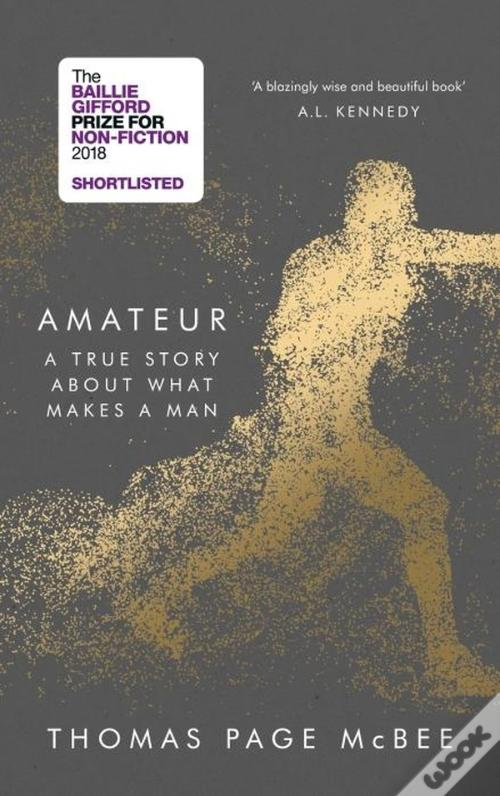
Thomas Page McBee
Amateur: a True Story about What Makes A Man
In wanting to research and write about the so-called crisis of masculinity, Thomas Page McBee takes up boxing, and trains for a fight in Madison Square Garden, becoming the first (that we know of) trans man to do so. A great hook, a… so-so book.
McBee covers a lot of ground, though not necessarily in much depth. How the more you use your body, the more you become aware of its connection to core facets of your personhood. How everyone is expected to pass as an easily parsed gender – whether trans or cis, but especially in the world of boxing, specifically men – and failing at doing so invites violence. How the permissions granted if you succeed at passing come paired with prohibitions, blind spots, behaviours that might not align with who you want to be. How queer people, shaped by a life of self-defence, are often unaware of how they turn that internalised reactionary streak on themselves. For many readers, a lot of this is Gender Stuff 101, but for others, I suspect it might be quite eye-opening; I wonder how much really crunchy queer shit McBee held back, in order to speak to the latter audience.
And yet, for a book about the defensiveness and conflict inherent to heteronormative masculinity, there’s… very little conflict. Everyone’s nice. The lads McBee trains with are overall pretty decent, and none seem too afflicted with the misogynistic shit that comes with having rolled high on privilege. Although this perhaps isn’t explored, because we rarely see them (or McBee himself) interact with anyone who isn’t also a man. McBee finds much-needed community in boxing, but does very little to critique its highly-policed edges. Once he steps into the ring, the Brotherhood of Man accepts him, even when he doesn’t accept himself. Which is heart-warming, but not exactly the thesis which opens the book.
Ultimately, the “true story” of it all becomes limiting. The day of the big match arrives, and McBee does not miraculously win the fight after receiving nearly no training – in fact, sitting with his failure to be a Socially Acceptable Man is the entire point. But multiple emotional subplots don’t resolve satisfactorily, due to shame, embarrassment and general ambivalence on the parts of the men involved. Which is how real people behave, and McBee can’t spin their behaviour differently for the sake of a neat bookend or a great revelation.
An awkward epilogue, in which McBee reveals his transness to his trainer, plucks out the one interesting thorn: the question of disclosure. He doesn’t, until after the match, want to broach this subject at all, fearing it’ll skew the story he’s trying to write, and how other men relate to him. Which, well, probably! But there was something uneasy in that lack of disclosure that held the book together – nobody queer owes cis-heteronormativity full access to their identity, especially not when putting themselves at physical risk. I got the feeling the epilogue was likely requested by an editor to address the book’s overall lack of resolution.
As a result, the most memorable lessons actually come from McBee’s sister, and a woman he spars with, but they’re given significantly less space on the page than the men achieving selfhood through violence with other men. You can draw your own conclusions on what that says of men.
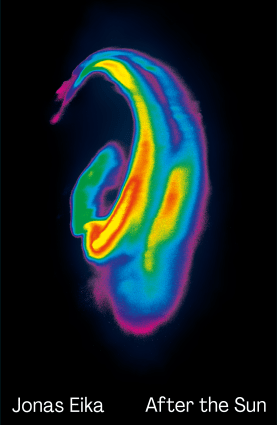
Jonas Eika
After the Sun
I adore the cover of my edition. That fading heat map swirl is confident and enigmatic and otherworldly but also strikingly soulless – which happens to be how I’d describe this collection. And oh, how much I wanted to love it. Alas, not so.
General consensus seems to be that the highlight is ‘Bad Mexican Dog’, a hallucinatory blend of sun, sea, sex, blackmail and magical pool boys reanimating colleagues with parasols and piss, but under the shock value, I couldn’t discern much of a story. The same, I suppose, could be said of my personal favourite, ‘Rachel, Nevada’, in which a man takes the opportunity of his wife attending a psychic life coaching seminar, to merge with an alien artefact in the desert, demonstrating some of the most viscerally repulsive self-harm I’ve read in a long, long time.
And yet. Hmm. Every story sat right on the cusp of pulling me in with heartless concepts and impossible body horror, abstracted critiques of late-capitalism, prose poised between academic rigour and freewheeling surreal nonsense. But the collection’s veneer of alienation never cracks to expose the inner lives of its characters to any palpable degree, nor the reasons for the stories.
Yes, I know this is similar to the emptiness I loved in Mystery Lights, but the difference between these two books is similar to the difference between one-way glass and a mirror. Both invite self-reflection, but only with the former can you convince yourself you’re not alone. It’s the veneer itself Eika wants to examine, not what’s behind, and there’s only so long I can stare at the surface level before I feel pushed away.
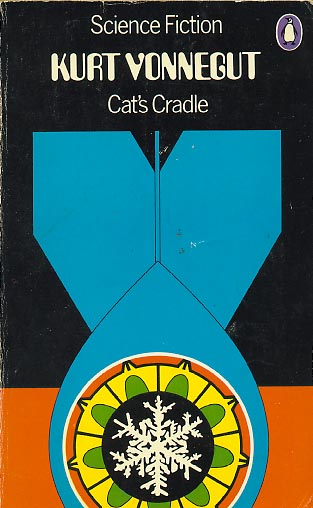
Kurt Vonnegut
Cat’s Cradle
Jesus, but this was a downer, and I say that as someone with a high tolerance for Vonnegut’s cynicism.
What begins as the narrator’s research into important persons’ activites during Hiroshima briefly becomes a madcap investigation into Ice-9, a compound that could instantaneously freeze all water in the known universe, and ends up dabbling in a parody of the Cuban Missile Crisis, before the inevitable occurs.
What usually offsets Vonnegut’s doomer impulse is his inclusion of surreal, spiritual, ironic perspectives that exist outside of humanity’s tendency towards self-destruction. Which here is Bokononism, a cultish nihilism riddled with meaningless coincidences and daft terminologies. But, its presence is too slight and, frankly, too annoying to alleviate the actual crisis of the story. Cat’s Cradle says, you have to laugh or you’ll cry, then doesn’t give you anything worth laughing about.
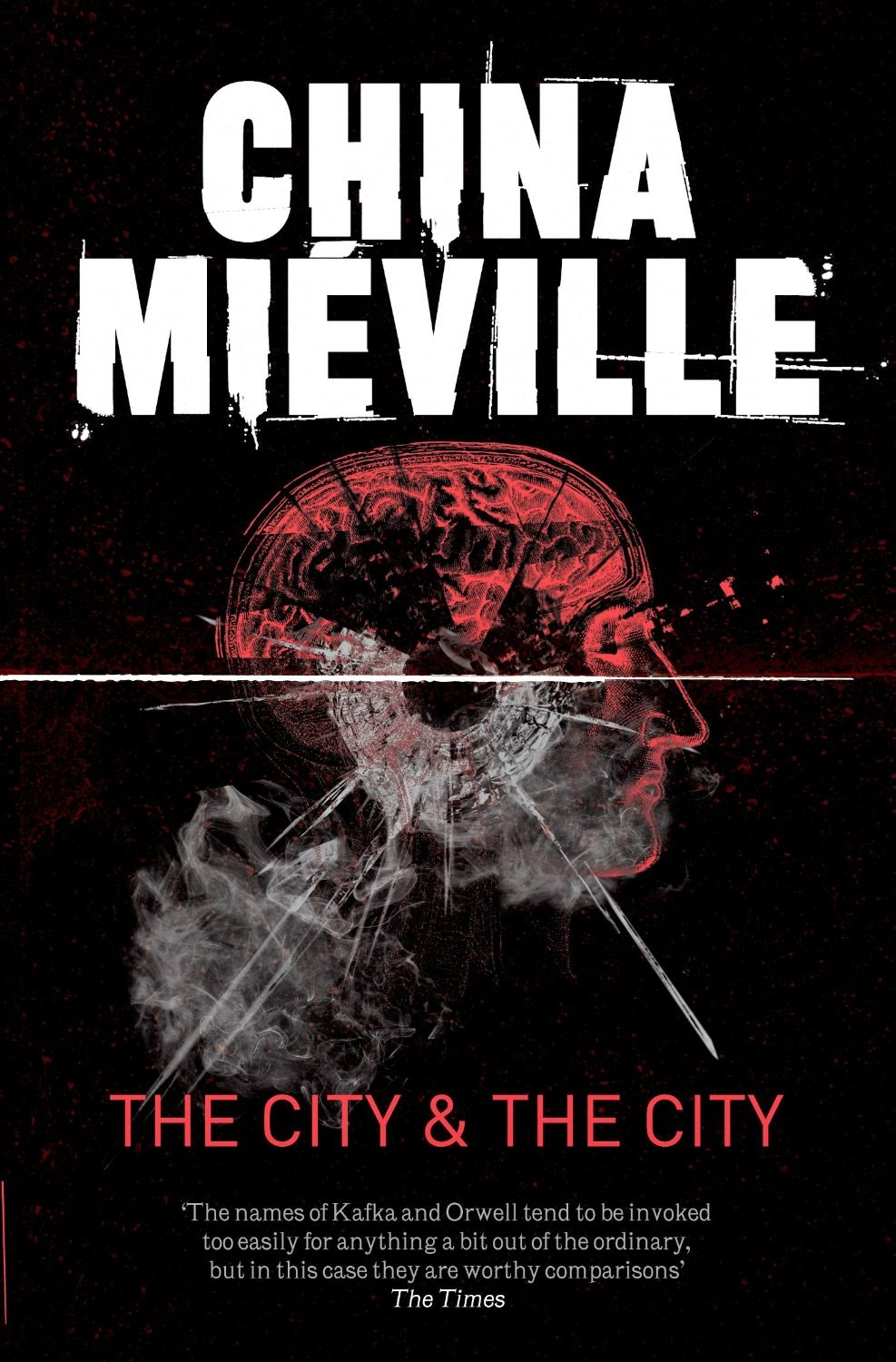
China Mieville
The City and the City
I was 23 when this was first published, which is wild – it’s such a heavyweight in speculative fiction, I thought it must’ve been published long before I started taking an interest in the genre. So it’s possible I came to this with expectations set a little too high, but I found it overburdened by its concept. For those who aren’t familiar: a murder takes place in two cities that exist superimposed over each other, and one detective’s attempts to figure out the means, method and execution requires breaking arcane laws which prohibit the residents of one city observing the residents of the other.
This symbolism is true of some cities close to my own heart. As a teen, a journalist allowed me to ride along with him as work experience, while he gave diplomats from London a tour of Belfast. After half an hour, the diplomats asked if we’d been driving in circles, when we hadn’t. They were gobsmacked at how patchwork the different districts were, how invisible the boundaries. I think they’d conceived of Belfast more like the opening of the 90s X-Men cartoon, Protestants on one side, Catholics on the other, charging headlong to fight centre-screen where “normal” people scrambled out of the way. Now I’m older, I see this better not as naivety but wilful ignorance. These people didn’t know about the complexities of Belfast, and truly didn’t want to know.
Spinning that impulse into speculative worldbuilding is, let’s not muck about, a great concept. Unfortunately, it wore thin quickly. Mieville is constantly at pains to ensure you understand the idea at its most basic level, even three quarters in, when the plot necessitates you throw that understanding out the window. Also, the act of “unseeing” the other city is clever, as a device to communicate how we pretend parts of our world don’t concern us, but at times you get the feeling Mieville’s actively unseeing the story he’s telling. A good mystery freely gives its readers well-camouflaged clues which they might assemble into truth, allowing the finale to be a short sharp burst of consequence. The City and The City does not do this. It withholds clues and deeper analysis, filling the space with thematic noodling, then surprises you with a villain whose motives remain concealed while the detective monologues how he figured everything out, with details the reader doesn’t even know he’d encountered.
It turns the book into a parade of locks with no keys – very frustrating, and not the totemic genre staple I’d been expecting.
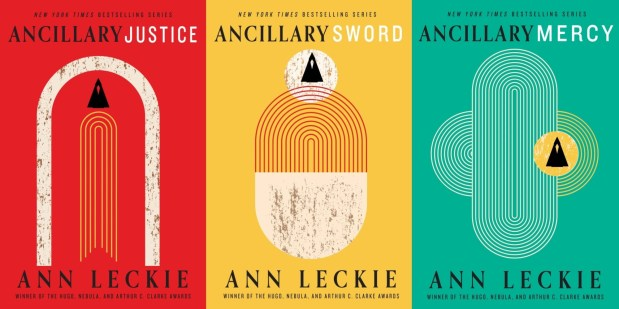
Ann Leckie
The Imperial Radch Trilogy
We all know the horse drawing meme, right? Where the arse of the horse is impeccably drawn, the middle a bit shonky, the head at the other end derpy as hell? Well, I’m annoyed it took me until halfway through the third book of the Imperial Radch Trilogy before I realised this horse wasn’t gonna get un-derped.
Ancillary Justice is great. Protagonist Breq exists somewhere between an android and a corpse, the last remaining fragment of an AI that used to be a galactic warship staffed with reanimated bodies of conquered populations. She’s hell-bent on revenge against the multi-cloned hivemind godlike emperor, whose betrayal many centuries beforehand not only destroyed her life, but destabilised the Radch Empire. Told in alternating chronologies – the betrayal and the revenge – you get a sense of this empire as vast, the emperor as terrifyingly multitudinous, the femme-genderless Radch empire nuanced and blunt in all the ways empires have to be if they want to remain empires
Ancilliary Sword chucks all of that, to zoom in on one planet and orbiting space station as a microcosm of this empire. The plot is vaguely interesting – tea trade, indentured labour, classist prejudices, a historical conspiracy - but suffers from losing sight of the murderous motivations that fuelled Justice’s expansive worldbuilding. Breq, now hooked up once again to a warship, loses a large degree of her charm as a warship learning to be human; now capable of reading her staff’s emotions and minds by spying on their vital signs, the narration becomes an exercise in head-hopping. There’s a reason much writing advice warns not to do this – characters become parodies of themselves, locked into stagnant personalities, for fear you might not recognise them next time Breq invades their privacy. A curious moral quandary, you might think, worth examining in the next book.
Nope! Look. I know wrapping up a trilogy must be difficult, especially if the readership most likely to buy the third book responds positively to aspects of the second that, for want of a better word, read as cosy. But this trilogy did not start out cosy. In fact, the cosy aspects of the Radch empire – elaborate tea rituals, progressive gender politics, slapstick alien representatives, an ability to be known entirely by another entity – all explicitly stem from the injustices it inflicts on the societies it ruins. That was the good shit! After condensing the story to a microcosm where the upper classes dominate the narrative, I was looking forward to a return to all that raggedy discomfort we left behind in Justice. But closer Mercy takes everything that doesn’t work with Sword, and does it more, and makes it cosier.
There are probably more charitable readings of how the series ends, but to me, it betrays its own radical anti-colonialist origins, arriving at a damp squib of a finale that excuses, if not empire, then the individualism at the core of empire. A derpy horse, indeed.
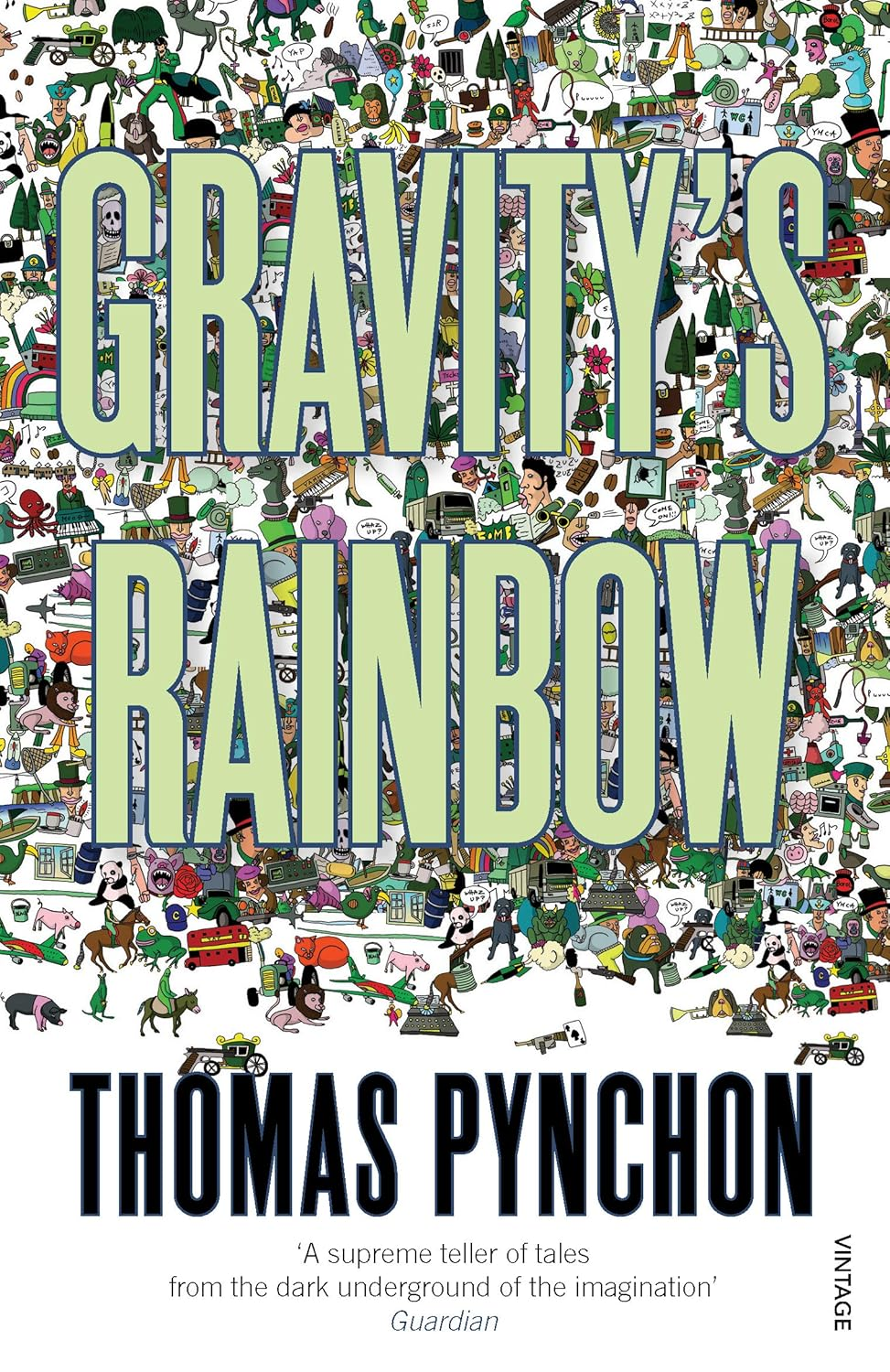
Thomas Pynchon
Gravity’s Rainbow
I told myself I would read a normal-length book’s amount of Gravity’s Rainbow, and if it hadn’t grabbed me by then, I wouldn’t bother with the rest of it. I loved The Crying of Lot 49, and hoped that same superstitious mania and doomy paranoia could be sustained across something massive, but I’m not sure it can? I think I managed two normal-length books’ worth before giving up.
I also think, like many war books, it assumes a certain level of familiarity with the ins and outs of military service, as many more people used to gain first-hand experience of that life than they do now. Without that familiarity, a lot of the organisational logic of this book went right over my head. Let it be known: I lacked the stamina and the curiosity needed for Gravity’s Rainbow. Frankly, I blame social media.
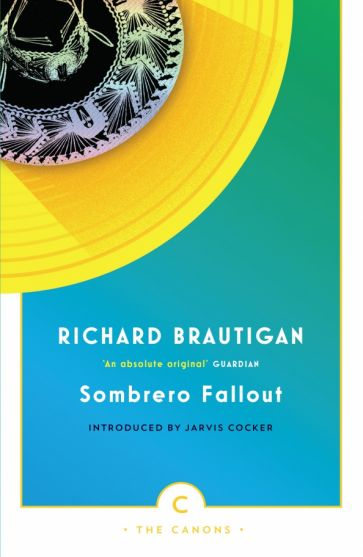
Richard Brautigan
Sombrero Fallout
Never say I do not have an open mind – after my disappointment with Hawkline Monster (more on that in a moment), I gave Brautigan a second chance at prose. Shouldn’t have bothered.
An ice cold sombrero falls out of the sky and, when the residents of the town in which it lands lose their minds over who should be allowed to wear it, the violence escalates into world-ending farce. Meanwhile, in alternating chapters, the fictional author of the book, who is definitely not Brautigan, trauma-dumps on the reader, so depressed his blatantly fetishised Japanese girlfriend has broken up with him, he might just kill himself.
Is the sombrero story funny? In the same way your narcissistic mate down the pub might stretch out a mildly humorous anecdote, so the spotlight of attention rests on him a little longer. But in Sombrero Fallout, the only person Brautigan shares that spotlight with is a fictionalised version of himself, and that guy’s such a pathetic sad-sack, with a tendency to self-deprecate into a pit of misery. I started skipping his chapters, keen to return to the sombrero. When the violence finally erupts, there’s a good few pages where all his pent-up dissatisfaction finds release in some entertaining slapstick that, if it weren’t so indiscriminate in its targets, could read as gratuitous. I dunno, maybe it is gratuitous. But it’s a glimmer of comedy and action in a book which otherwise staunchly resists any kind of pleasure or movement.
A disturbing wrinkle: Brautigan married his second wife, Akiko Yoshimura, the same year Sombrero Fallout published; she divorced him four years later, and four years after that, he killed himself. He obviously needed more support than he received, but his prediction of his own life gives this book a marginal redeeming macabre aspect of curiosity. I would love to know what Yoshimura thought of it.
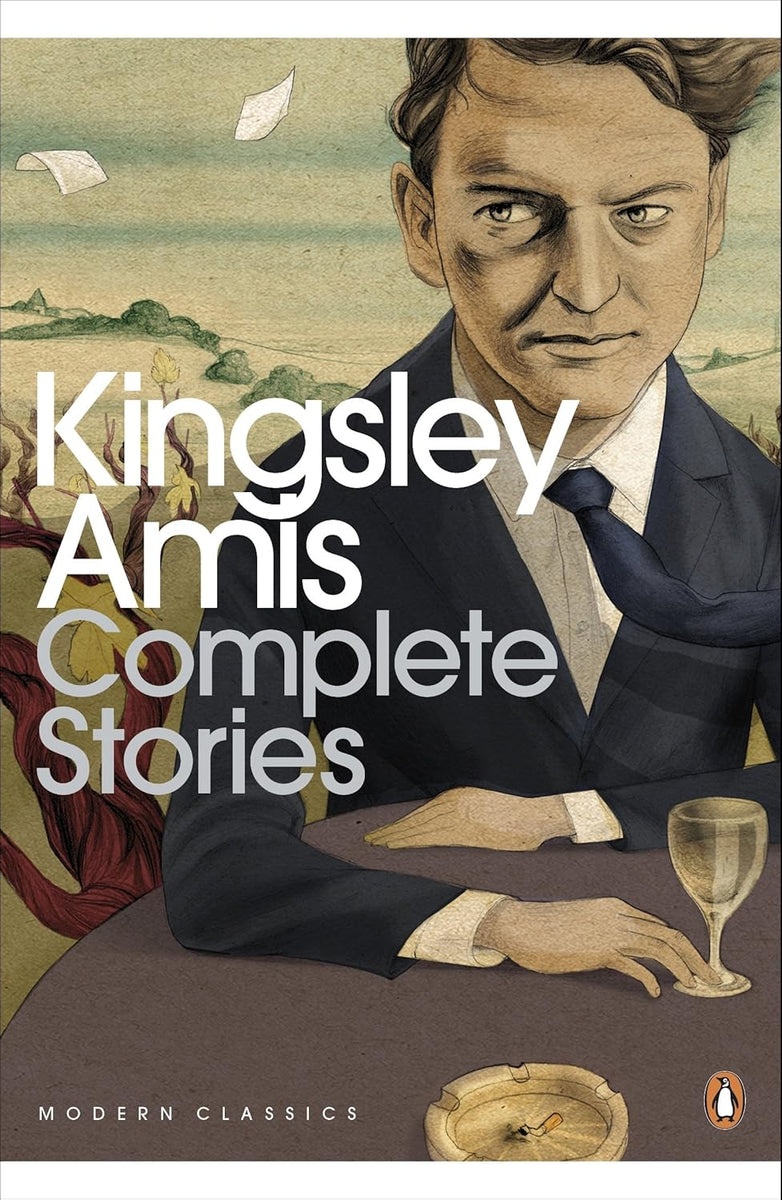
Kingsley Amis
Complete Stories
Not knowing much about Kingsley Amis, I picked this up from an academic pal getting rid of books before they moved house, drawn in by a blurb that foregrounded some of the more speculative works that I assume occur towards the latter half of his career. Reading chronologically, I tired quickly.
I knew something wasn’t clicking with me from the outset. The opening stories (presumably his first published) circle around social mores in military service, petty little tales about soldiers pulling strings to make sure some old boy doesn’t get a promotion he doesn’t deserve on account of being a rotter, or majors and generals convincing themselves they’re not bigots, because it suits their career goals to allow people of colour to serve. Don’t get me wrong, I’m not a moral purist, but the lesson these stories arrive at isn’t so much, “war requires you to compromise your values”, but “what’s the fucking point of bothering to be good?” These were followed by a damningly long story about ministers backsniping each other in parliament, where Amis seemed to be poking fun at their detachment from general society, but couldn’t quite hide how enamoured he was with their status.
And then, the one that put me right off the collection: a story about an upper-middle class office worker who disagrees with his wife’s choice of cleaning lady on vibes alone. He’s quickly proven to be a good judge of character as, enabled by her overbearing and farcically socialist support worker, the cleaning lady turns to a much more profitable (if obviously morally depraved) line of sex work and, in doing so, secures a soft foreign husband, who the protagonist pities for not being able to resist the woman’s feminine wiles, as he did a few pages prior due to his obvious moral superiority
Only then did I look Amis up, and discover his history as an ex-communist turned right-wing thinkpiecer with a reputation as a misogynist with xenophobic, antisemetic leanings. I’ll admit I’m curious to see how this mixes with the sci-fi flavour of his later work – it’s not a genre I personally associate with narrow-mindedness – but I don’t know if I can stomach giving more time to him, when there’s so more enjoyable, optimistic, idealistic and challenging work out there.
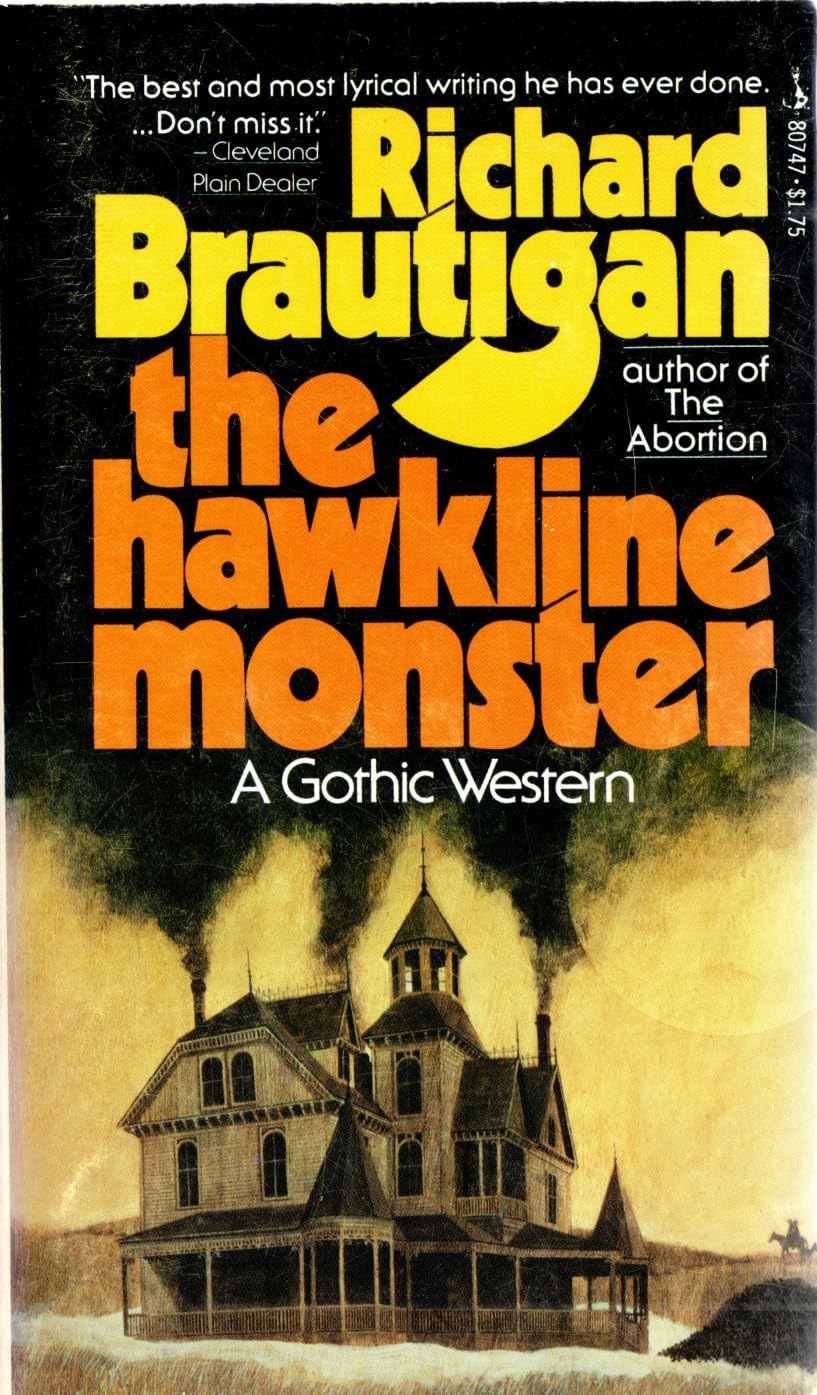
Richard Brautigan
The Hawkline Monster
Didn’t like, didn’t finish, didn’t even get close to a semblance of a story, which I had to look up on Wikipedia: Two Wild West assassins are tasked with killing a monster under a science lab in a gothic mansion surrounded by an oasis of ice in the desert, but it turns out there is no monster nor any caverns under the mansion, only the strange reality-warping effects of the chemicals in the lab, nullified by pouring whiskey into a beaker, at which point the missing scientist turns back from an umbrella stand into a human being. Obviously.
I like Brautigan’s poetry. The surreal and often meaningless imagery works in tiny doses, like Rene Magritte paintings. One framed painting of a floating apple is art; cover the walls with dozens of posters of floating fruit, and you suddenly find yourself in the dorm room of the most irritating person you knew at uni. Especially when half the posters aren’t of floating fruit, but of 40 year old assassins fucking children.
Yeah, so, turns out I have an Instant Dislike button, and it’s Born Sexy Lolita Twin Sisters, never definitively given ages, but only ever depicted as extremely sexually active and alluring children under the influence of magical chemicals. Maybe it was easier to publish psychedelic paedophilia in 1974, but it’s certainly not an easy read in 2025.
Best Book Covers of 2025

I hadn’t planned to make a list like this until LitHub and Casual Optimist dropped theirs, and if this list looks mostly like I cherry-picked my favourites from their lists, well… that’s exactly what I did.
I feel a little guilty copying their homework, but Best Book Cover lists tend to feature a lot of overlap anyway. LitHub’s in particular is composed mostly of designers working in-house with studios and publishers, recommending the work of other designers working in-house with studios and publishers, all of whom have marketing budgets designed to boost certain books, and getting on the LitHub list is part of that marketing, so even if these covers are very good, there’s a feeling of manufactured consensus. Which is… well, it is what it is. I like to think if I’d spent the year curating a selection of my own, the ratio of curveballs to group consensus would tend towards the curveball. But I didn’t, so here we are.
Anyway, Best book covers of 2025, lets go.
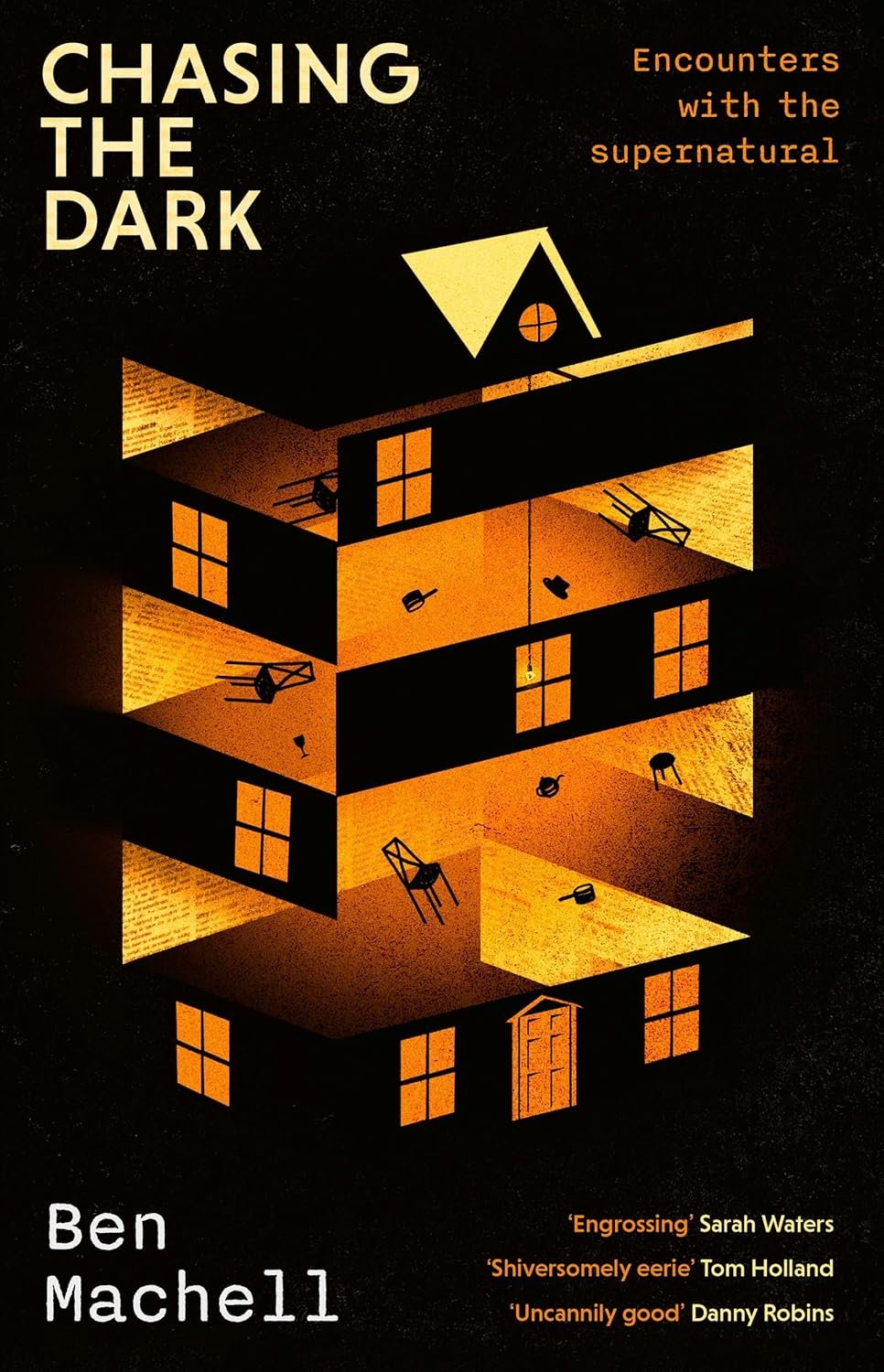
Ben Machell
Chasing The Dark
I can almost hear those pots and pans being poltergeisted around the house, which itself is shapeless and almost not there, more a ghost of a maze composed of lovely grainy textures going at wrong angles to each other. I feel there’s probably more than a little inspiration taken from the poster for Hereditary, with its puzzlebox house, but this also feels very much its own thing.
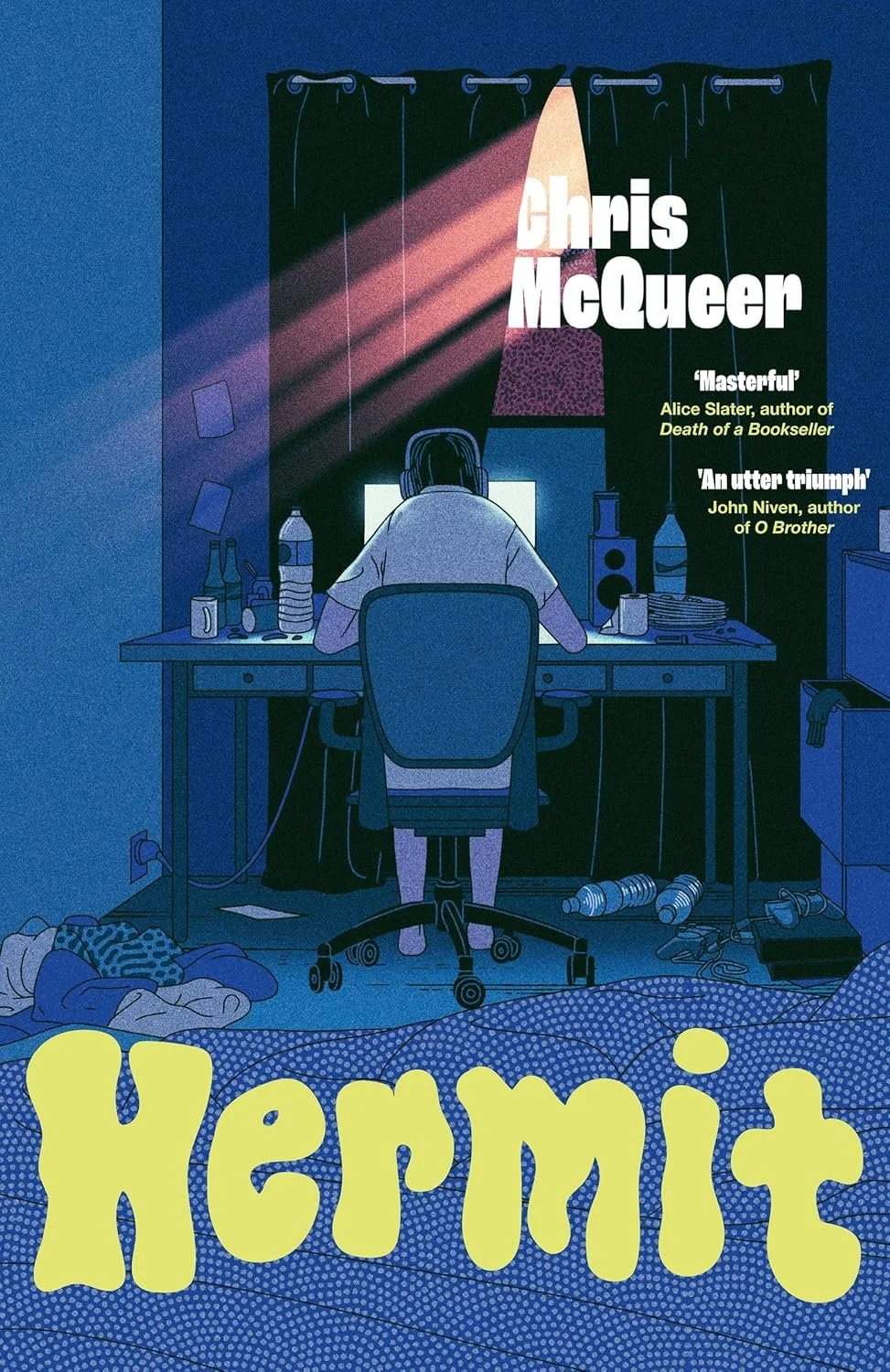
Chris McQueer
Hermit
I don’t often go for wholly-illustrative covers. I’m jealous, pure and simple, of people who can work that sort of magic. Yet not only does the illustration here hit all the marks - loneliness, chaos, self-loathing, a hint of redemption with church-like crepuscular rays of the outside world creeping through the curtains, that terribly sad little loo roll on the desk – not only all of that, can we talk about the title treatment? The audacity? Of setting the title? For a book about incels? In a blobby pale goo? That can only really bring to mind? Cum?! Quite literally gooped and gagged.
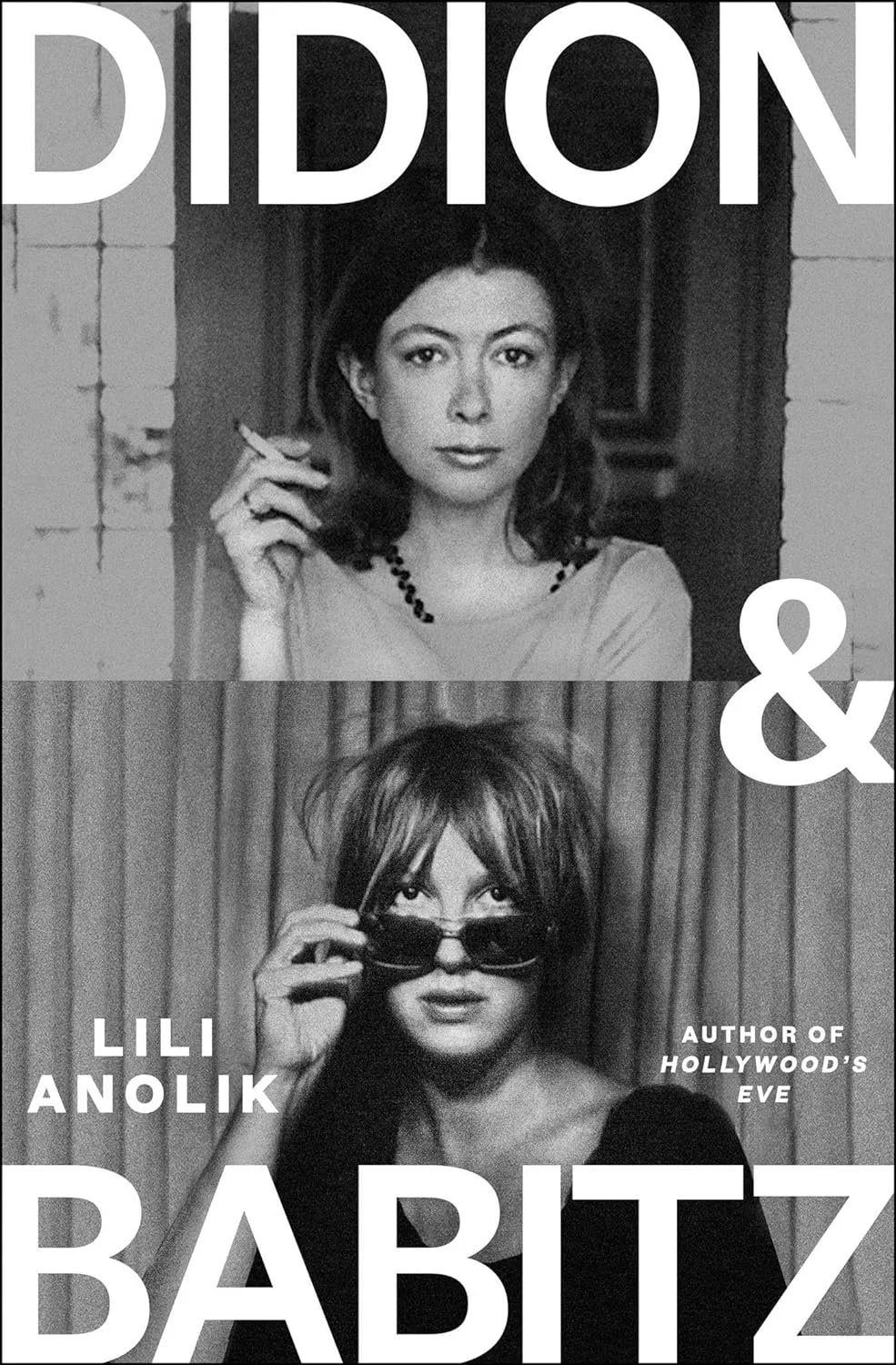
Lili Anolik
Didon & Babitz
On a crowded display table, this will be the first book you see, I guarantee. It feels loud and too close, like an argument crashing through from another room. And what of that argument? It sets up the rivalry between Didon and Babitz by giving each woman equal space, refusing either the focus. Didon, cool and collected, neatly framed and on top, only has to contend with her name hovering above her like a halo. Meanwhile a frazzled Babitz, glaring up at her competition, feels hemmed in and hassled by her name, the author’s name, the author’s credentials, the irregular pleats of a curtain sitting too close to her back. Without reading a single word, you get a sense of how each is positioned in this rivalry, how each regards the other. That’s storytelling, baby!
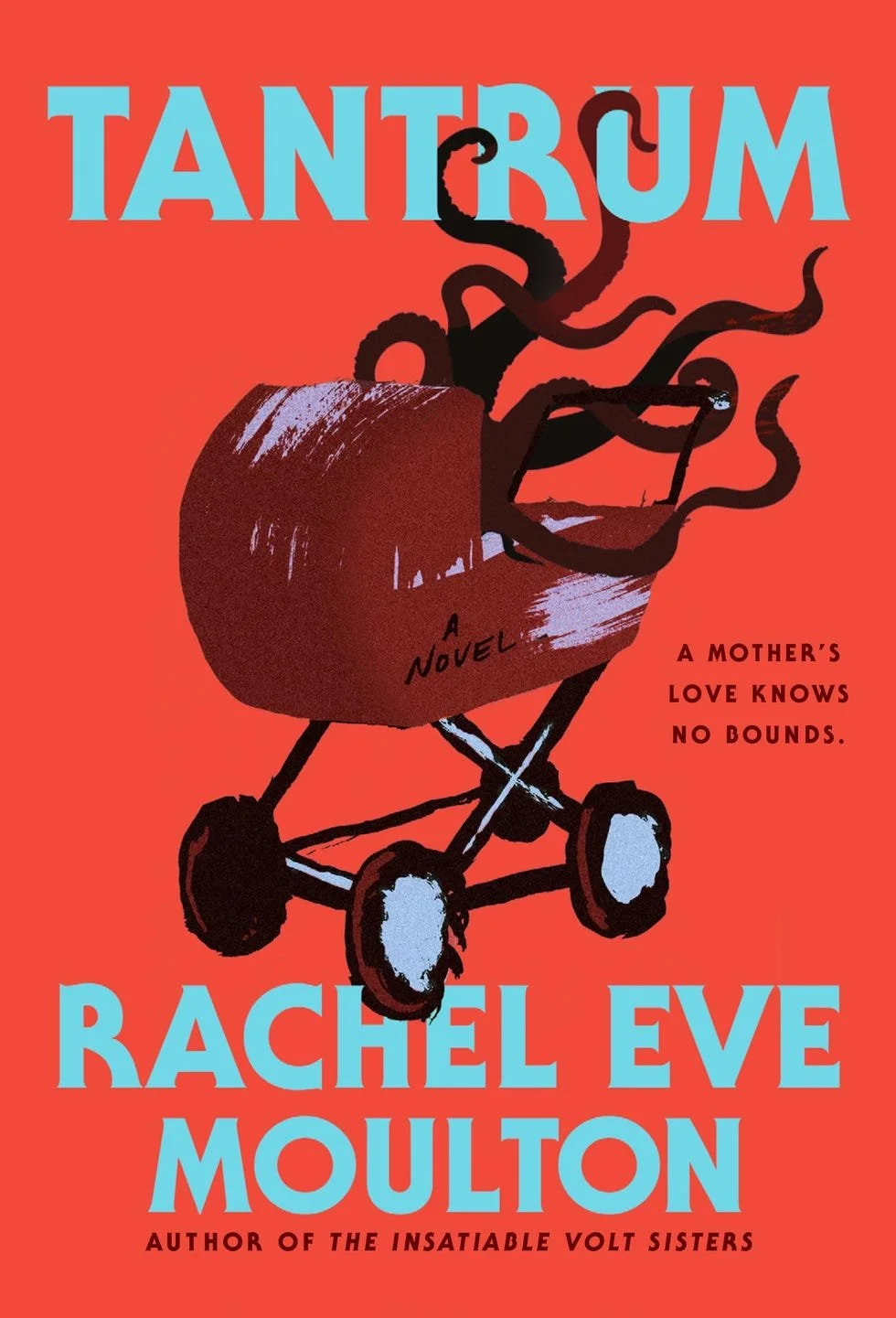
Rachel Eve Moulton
Tantrum
Sometimes when you know you’ve a strong image, such as tentacles bursting out of a vintage pram, you don’t really need to complicate things further. That said, the colour choices are what makes this, for me – the slightly-too-corpse-grey-to-be-baby-blue type, clashing with the mismatched violet highlights on the pram and wheels, which clash with the maroon bassinet, which clashes with the tomato red background. Everything’s a shade or two wrong. It’s great.
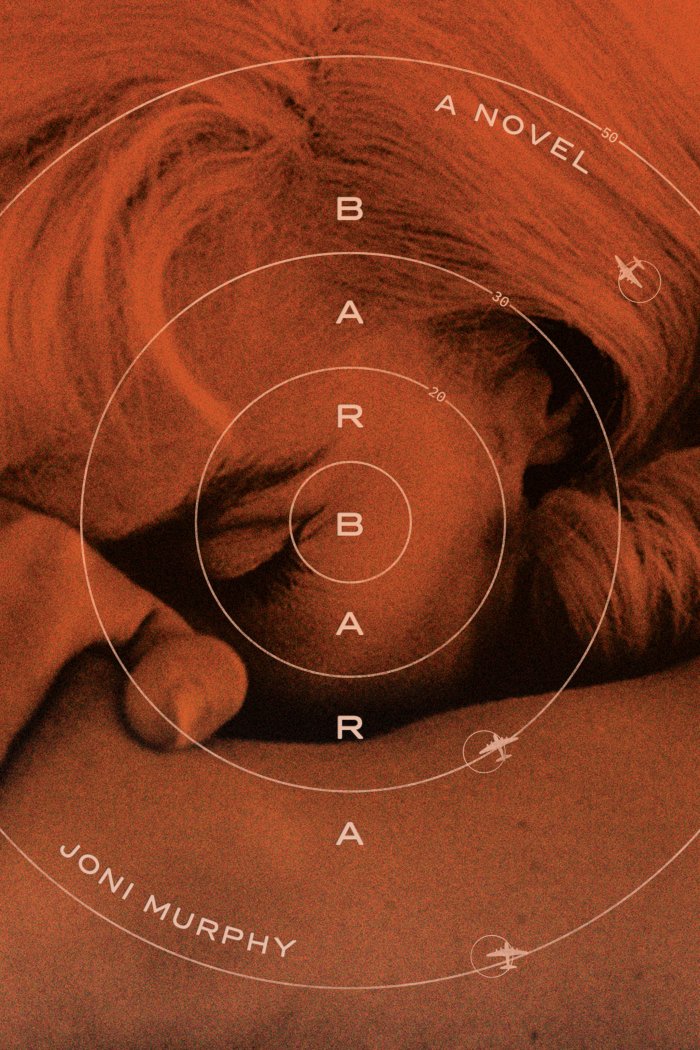
Joni Murphy
Barbara
The close crop on Barbara is unsettlingly unclear - is she resting, is she in distress, is she dreaming? It’s difficult to situate the story in a specific era, her Marilyn Monroe glamour not quite compatible, temporally speaking, with WW2 fighter jets. And all contained within an atom bomb’s blast radius, emanating out from her mind, suggesting shockwaves peeling back layers of identity, under a dense orange filter that’s just a little too saturated to be reassuringly nostalgic. There’s a lot going on here, vague but – much like the book itself, if reviews are to be believed – all tightly balanced like a fine hallucination.
Erik Carter
Design Harder
Oh, I hate this. Which of course means I love it. I’m not usually a fan of type-only covers, but taking “design harder” as a mission statement and thickening the stroke on the letters way past what “good” design would allow? It’s too clever.
Daniel Kehlmann
The Director
Inspired by the life of film director G.W. Pabst, who fled to Hollywood to escape the Nazis but later returned to create propaganda films for the German Reich, The Director’s cover doesn’t fuck about. The slightly off-brand Nazi colour scheme, the Art Deco typeface, the big egg-head and little spectacles illuminated from below, suggesting a dictator gazing down from on high, or a director watching back a reel, or perhaps even (and this is where my mind went first, which I’m sure was not the intended reference, but it’s not a million miles off, either) an occultist gazing into the Ark of the Covenant, moments before his flesh melts…
Dorian Lynskey
Everything Must Go
The outlandish sense of scale here is very fun – big big boom, itty bitty people. As is the ambiguity of what’s making impact. The fat tail says asteroid, the scratchy heatwave/corrupted VHS texture says atom bomb. The rustic woodcut town besieged by a colour out of space. Do I love the type treatment? Hmmm… I think it’s referencing vintage text-heavy newspaper headlines? I think there were probably many discussions about whether it should go at the bottom or the top of the page. I think, as I always do, that it doesn’t need to be so big. But! The title’s darkly funny and the image sells the concept, can’t really fault it for doing what it needs to do.
Harris Lahti
Foreclosure Gothic
It is nigh impossible to capture in print the eerie aesthetics of found-footage film, the experience of which relies on time passing, the image changing, the camera lingering too long on something empty, or something moving off-screen, or the viewer noticing something which someone within the frame has yet to notice, and maybe they will, maybe they won’t, but it’s the time it takes for them to see what you’ve seen, that creates the unease. Print doesn’t have the luxury of time passing - once you commit the ink to the paper, the subject becomes frozen in a moment. So, how to capture that Ring Camera panopticon uneasiness on a book cover? Two frames, identical but for a strange glow around the subject, standing just far enough away to not be a threat yet, but a little too close to not be a threat at all. Also, it would feel more natural to read the bottom image first: an escalation, a growing illumination. Instead, with the glowing figure read first, this feels like we’re seeing something uncanny cooling off. We’ve joined the story just a little too late, something’s just happened that we weren’t privy to. This cover gives us time and distance, but not enough of either to feel safe.
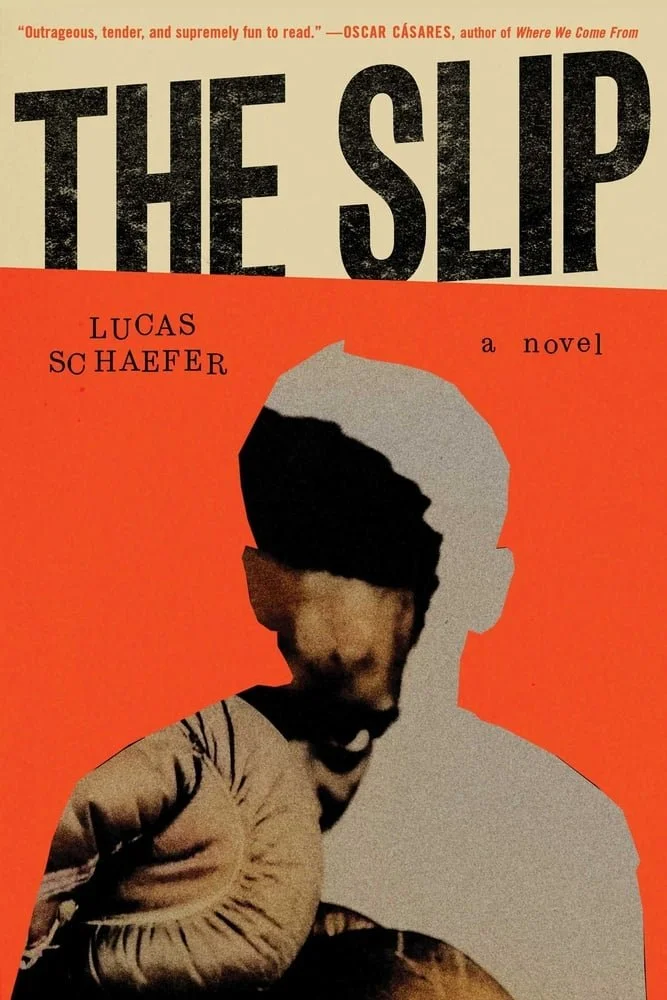
Lucas Schaefer
The Slip
A magic trick of misdirection – every single time I look at this cover – every single time – the flat orange and sharp line of the cut-out directs my gaze straight to where the cut-out’s face should be. It’s not there, of course, and only then do I feel my gaze pulled away to catch the eye of the boxer, blurred, grainy, muted, obscured, unseen, unexpected, and coming in with a mean right hook. Everything else is jostled, as if we’ve just taken a punch, and here comes another. I’ll come back to this tomorrow and it’ll happen exactly the same, like hearing a joke for the first time.
Mariam Rahmani
Liquid: A Love Story
In which an Iranian-Indian American woman goes on a hundred dates, tracked on a spreadsheet, in an attempt to marry rich. The writer in me appreciates the duality of the title, either referring to liquid assets, or something more sensual. Indeed, the UK cover makes the subtext text, with a watery type treatment and a close-up of sweat on skin, but I’m much more charmed by the US version, clunky as Excel, deliberately naive, dryly goofy. Like, yeah, sex is good, but when the shaggings done, you do want someone who can make you laugh.
Michel Nieva
Dengue Boy
If I’d written a book that presented even the slimmest glimmer of the cover featuring a be-sunnied mosquito man crossing a swamp under a planetary alignment with 2020s-psychedelia revivalist type rendered in a block-printing style, well, I’d want nothing less. Beautiful balance of colours, too, with the medicinal purple popping against an otherwise evenly matched sand yellow, blood orange and nursery crayon green.
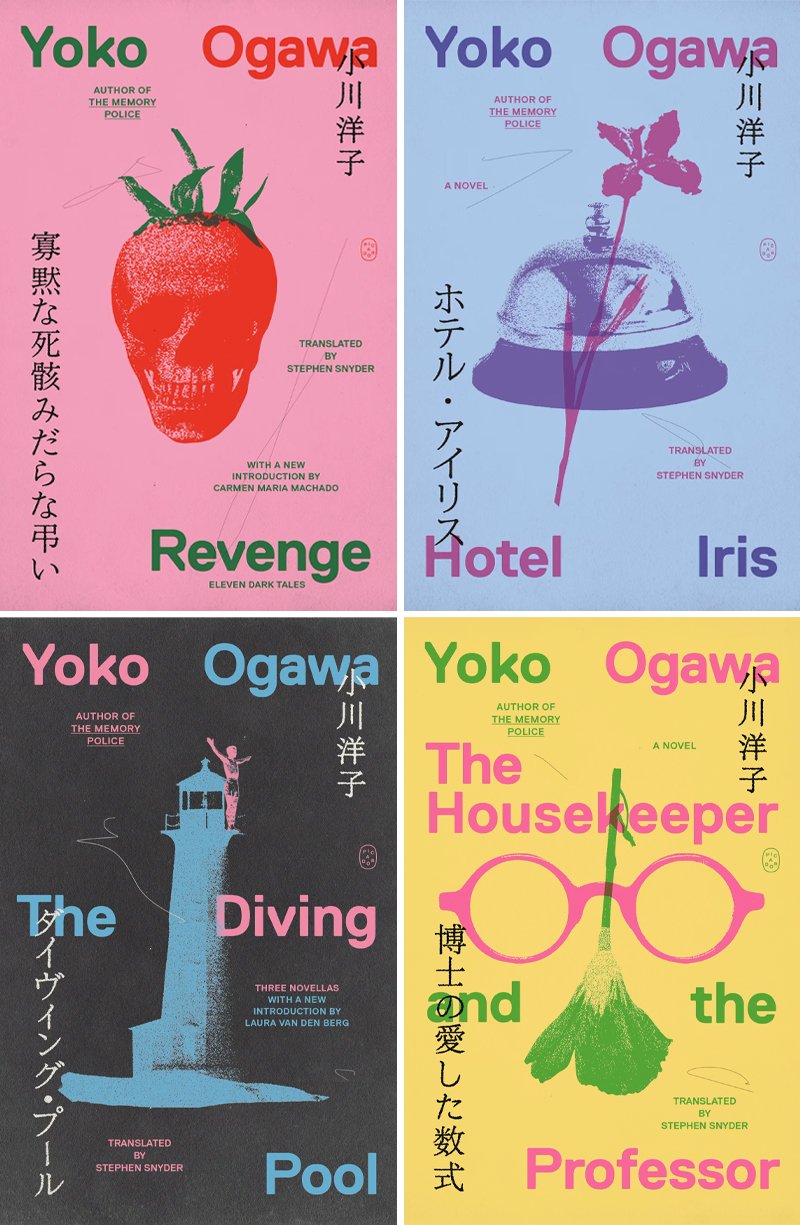
Yoko Ogawa
Revenge is the obvious stand-out with its skull-berry, but the series as a whole enjoys a brilliant balance of flexibility and rigidity, given how much content jostles for space on each cover. The placement of the author name, in Japanese and English, stays put across each title – along the top then down the right. That’s an important anchor. The Japanese title has a set location – it has to end at bottom left, but can stretch up to any height. This is mimicked by the English title, which ends bottom right but can also stretch to any height. The translation credit and the subtitle, however, go a-wandering, so as to keep out of the way of the image, always centred, always a superimposition, echoing the overlap of the two languages. Taken individually, they could read as messy, disjointed; taken together, a system emerges, not so strict that it can’t be playful.
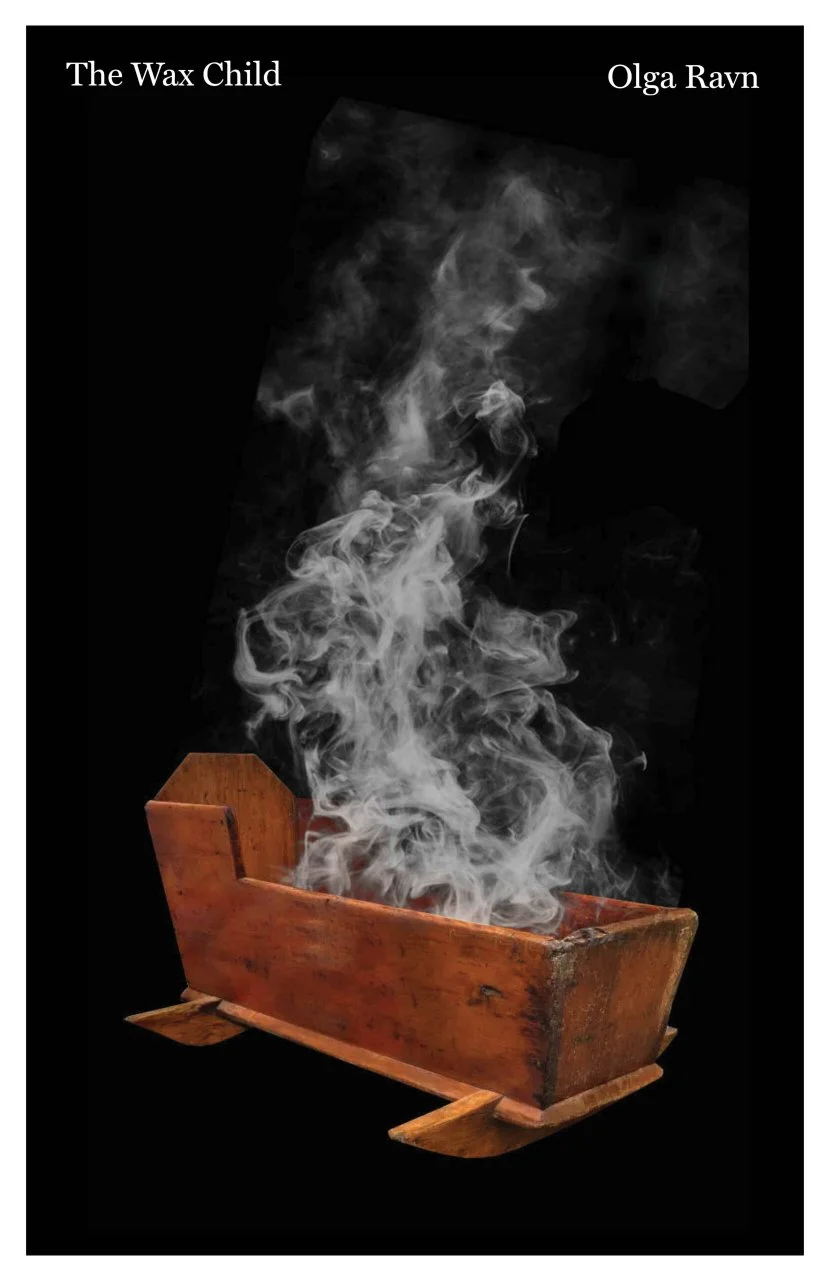
Olga Ravn
The Wax Child
See? See what happens when you don’t splash a title across the middle of the design in supplication to the Thumbnail Gods? You get to gift the entire cover – the entire cover! – to a haunting image of an unseen wax baby going up in smoke inside a creepy-ass bassinet* that looks more like a coffin. Go on, picture this with giant yellow text obscuring most of the smoke and the rocker. Rubbish, isn’t it? The image is strong, but the design choice to get the hell out of the way is what makes this sing.
*I was not expecting to use this word twice in one post.
Vauhini Vara
Searches: Selfhood in the Digital Age
Look, you do not, under any circumstances, have to hand it to Generative AI. The tech is perhaps humanity’s most unambiguously disastrous blunder since the atomic bomb. No good whatsoever can come of it. Except for this cover: an AI mimic of a still life, the focal point of a layout that riffs on John Berger’s Ways of Seeing, which famously delivered to the masses an accessible entry point to academic considerations of media literacy. It’s very clever, something GenAI is not.
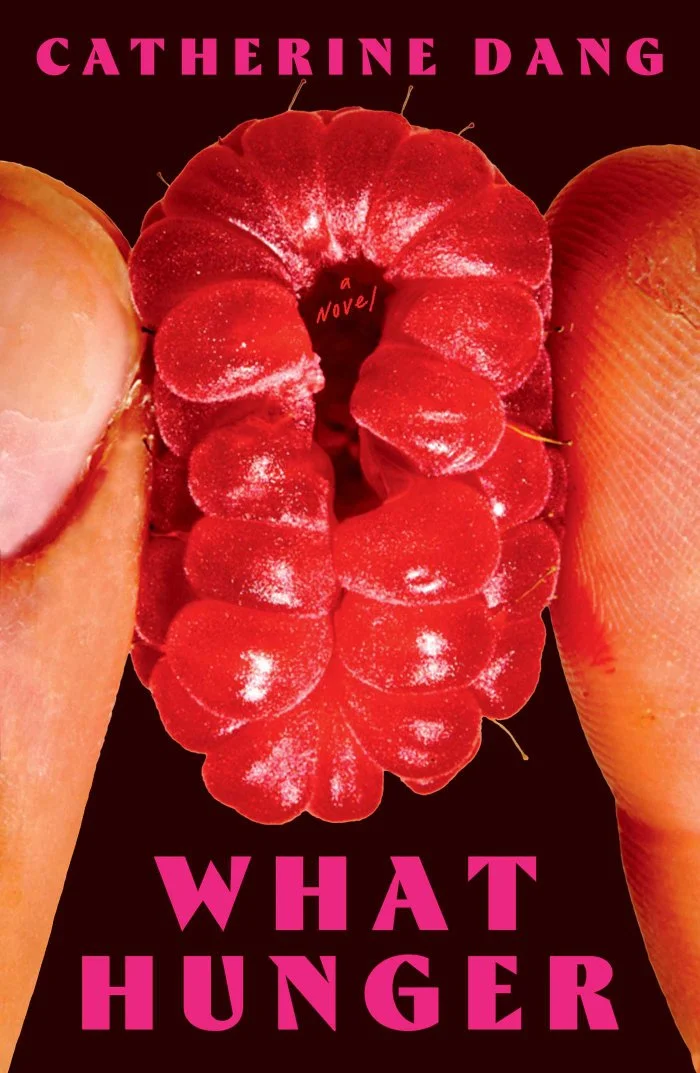
Catherine Dang
What Hunger
The close-up-of-fruit-as-symbolism-for-sex era is dead, long live the close-up-of-fruit-as-symbolism-for-sex era. That teeny tiny ‘a novel’ in the berry’s navel couldn’t get any smaller, so much so that I wonder if the designer didn’t want to add it at all, but it does add a little something to the extreme zoom. Also, girl? Moisturise.
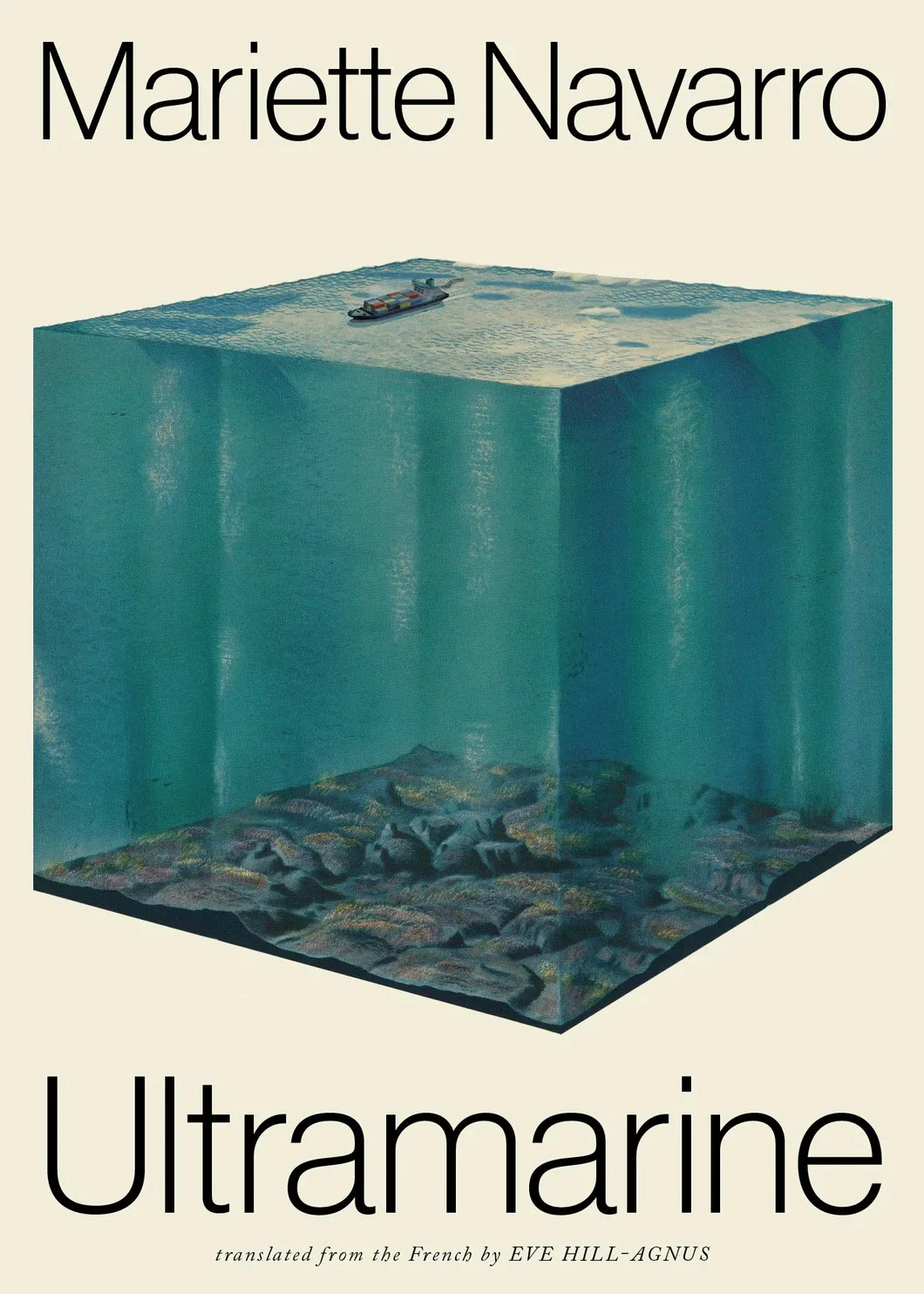
Mariette Navarro
Ultramarine
Who doesn’t love a big ol’ gelatinous cube of ocean? I mean, the Thumbnail Gods have struck again, but at least the typeface feels as artificially restrained as the cube of ocean. A lot of what I love here, I also love in the illustrative work of Owen D Pomery – the almost inconceivable difference between human scale and planetary scale, the imagined boundaries to something as boundless as the sea, the artificial clarity of an ocean floor seen in cutaway.
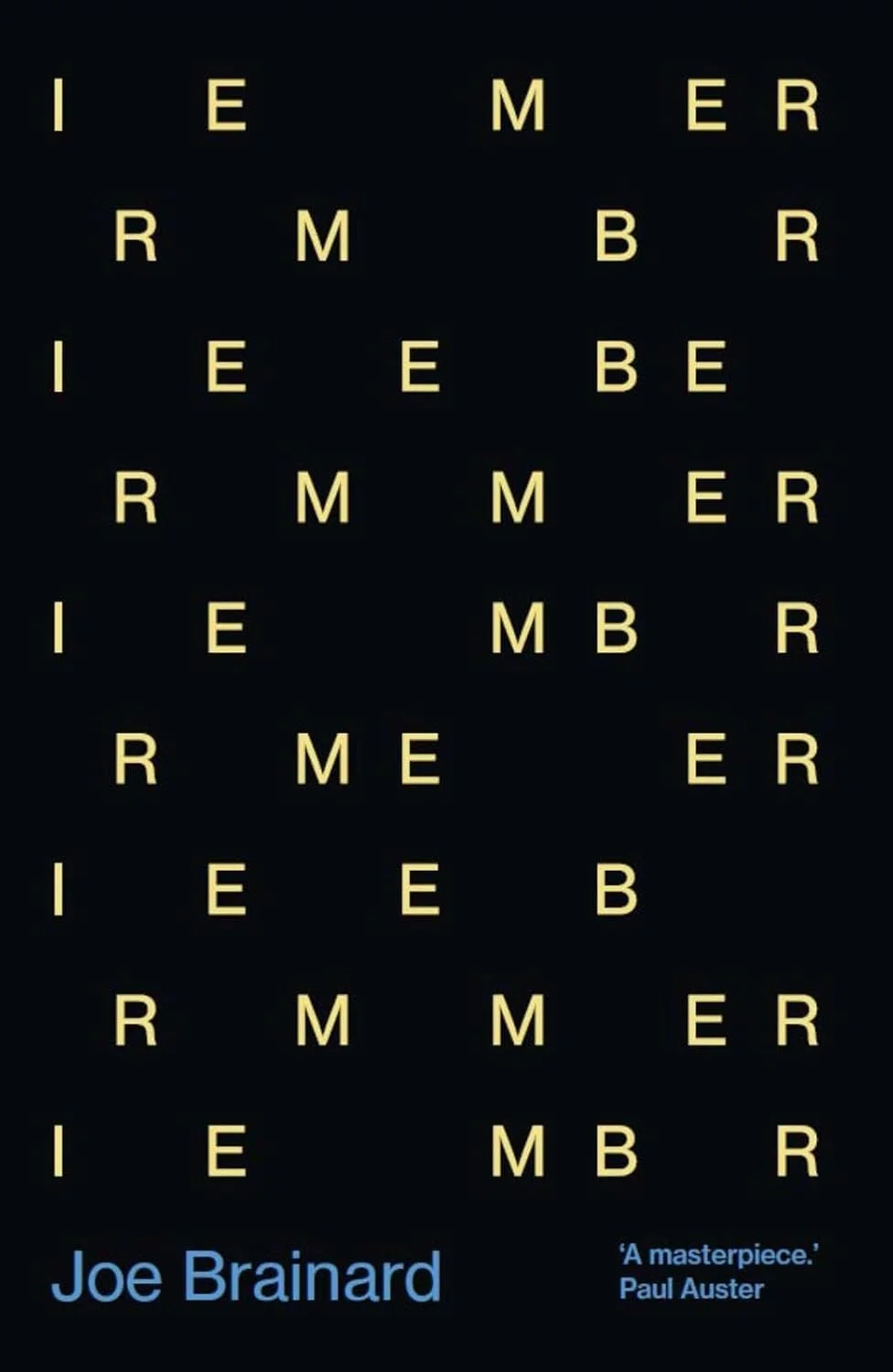
Joe Brainard
I Remember
High concept. Simple execution. No frills. In the words of Saint George Michael, if you’re gonna do, it do it right.
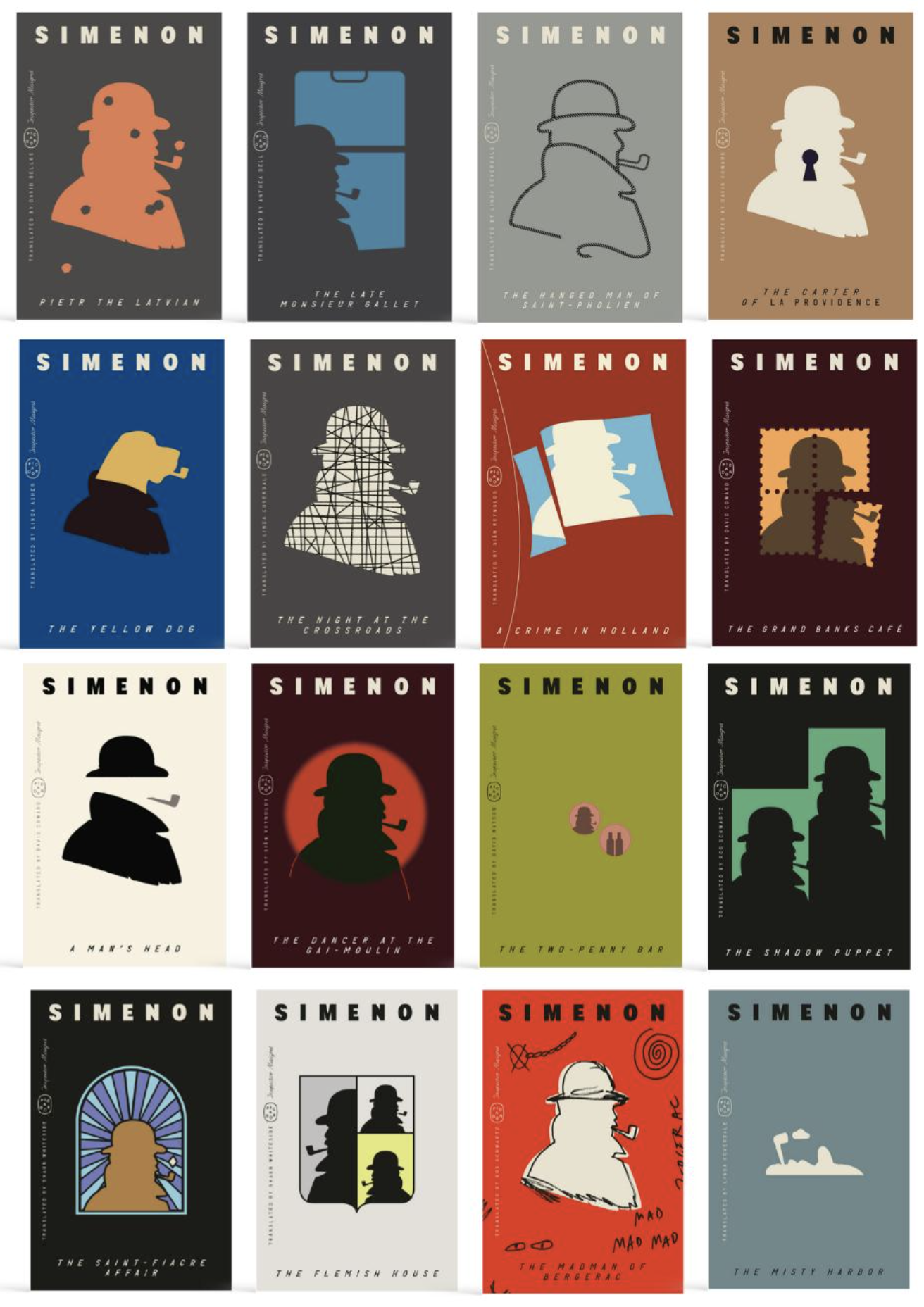
Simenon
Another series – and I love when you can tell the designer’ just having a lot of fun riffing one central image off as many themes a possible. My favourite, though, is bottom right, The Misty Harbour, silhouette of detective and pipe flipped 90 degrees to both be a sinking head and a steamy docks. I wish I could’ve been looking over their shoulder when they figured that one out, the unadulterated glee they must have felt!
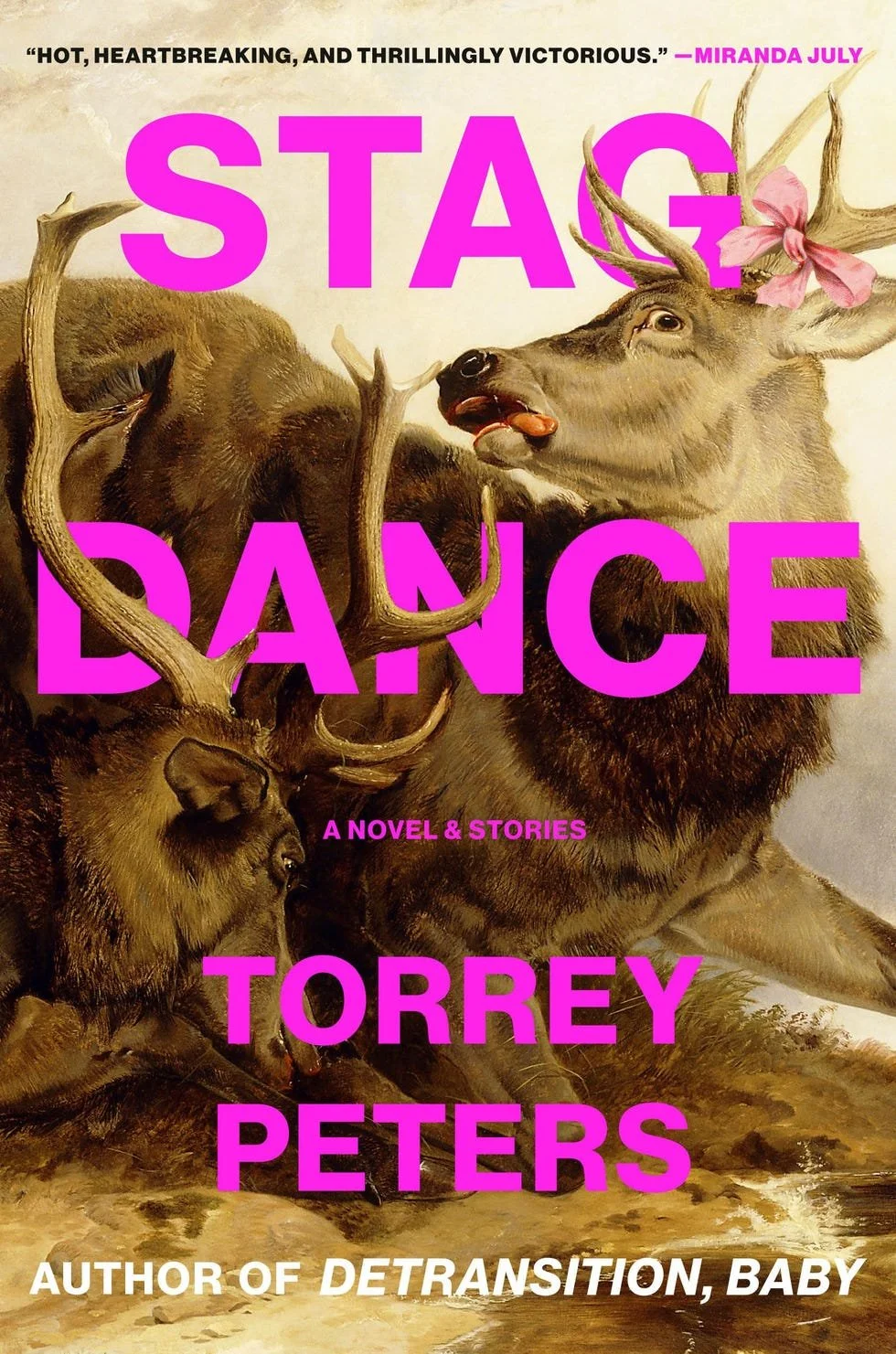
Torrey Peters
Stag Dance
I’m just about done with bright sans serifs being paired with awkward crops of paintings of animals in distress. But the bow. That fucking bow around the stag’s horn. One little pink flourish, and the stag’s horrified lolling grimace becomes something more like a silly selfie, one for the Gram. It says: sure, living is pain, but we’re damn fucking well gonna look cute while we struggle. If that ain’t camp, I don’t know what is.