A friend recently observed it’s galvanising, creatively speaking, when someone capable, and well-supported, comes up with a great idea, then fumbles the execution. I’m not speaking of schadenfreude, the critical equivalent of a comedically large prop knife with a ragged handle. This also isn’t a case of disliking a book because it isn’t what I personally wanted it to be, either. I wanted Newman to pull off a time-travel mind-meld meet-cute with grand aplomb. It’s a great idea. It’s her fourth book. Her prose is gorgeous.
And yet.
Our protagonist Kate lives in New York at the turn of the millennium, in an alternate world more progressive than our own. At a very fancy party she meets Ben, a perfectly nice young poet, and romance blossoms in utopia. Trouble is, when Kate falls asleep, her mind travels to Elizabethan England, where she is burdened with visions of apocalypse, and when she wakes, her present has changed, never for the better. As her relationship with Ben falls apart, mirroring a death-spiral America, an affair blossoms in 1593 with an obscure playwright called William.
It’s Shakespeare in Love meets The Butterfly Effect – epic in scope, rich with narrative possibility, and certainly Newman has the lyrical skill to do the concept justice. It just sometimes feels as if, once the idea found her, she didn’t know what to do with it.
The fumbling begins almost immediately, with world-building that reads more like a left-wing fantasy than a lived-in universe. An eco-conscious immigrant woman is President of the United States, elected on the back of a campaign funded by left-wing millionaires. UBI has been implemented, pollution is at an all-time low, protests are held nationwide unhindered by police, and it is the first year without a war anywhere in the world.
Are you annoyed by this utopia? Because I was. Or rather, I was annoyed by Newman’s entry-point: the rich-girl party hosted by Kate’s best friend (and one of President Chen’s financiers), Sabine. A multi-millionaire’s daughter, she allows all manner of interesting society to live, rent free, in her father’s multi-story Manhattan penthouse, including gay architects, environmental activists, ex-military veterans, and a Ukrainian filmmaker CEO of a mail-order bride rescue organisation. The next morning, this exceedingly civilised bunch gather for breakfast, where Sabine’s servants jokingly chase well-meaning hungover artists away from the kitchen.
It’s unfair to expect a utopia to follow all the same rules as reality – after all, if we lived there, we’d be home by now. But break enough rules, or break foundational rules, and readers familiar with genre fiction – or even just the concept of cause and effect – begin expecting explanations. What change occurred to the fundamental governing principles of the world we know, to allow for this fantasy? Where is the through-line?
Here’s a foundational principle: you cannot be a millionaire and be socialist. You can at best be a very philanthropical capitalist, but the means by which someone amasses a million of anything involves a level of extraction and exploitation and hoarding that is incompatible with socialism. Ideologies have boundaries, and if you step outside those boundaries, you step outside those ideologies. That’s how ideology works. That’s how definitions and language work. Point at a capitalist and tell me a they’re a socialist, and they only become a socialist if we both agree to completely change the definition of a socialist.
So, if you’re going to serve up a mega-wealthy heiress as the lynchpin to a utopia in which everyone has enough to be satisfied – including lawful good millionaires – you’ve got some explaining to do. Sabine is culturally progressive, financially [redacted], exoneration enough for the upper class socialites she surrounds herself with. But not exoneration enough for me. In this context, Universal Basic Income - an actual implementable real-world initiative that, should it come to pass, would require the sort of wealth redistribution and taxation on the super-rich that would make Sabine’s wealth unlikely - is assumed so patently impossible, it seems to have only been included in order to confirm the unreality of this utopia.
It only gets worse once we leave the penthouse. Those beautiful protests, those beautiful protestors – Newman never specifies what exactly they’re protesting against; without demands or grievances, isn’t a protest just a party? That’s the neoliberal platonic ideal of a protest: toothless and inconsequential, with no target or outcome, but it sure does make you feel good for taking part. And let’s talk about Sabine’s servants, because nobody else does! While we’re at it, who’s collecting this utopia’s bins? Who’s driving the buses? Who’s exterminating the rats in the subway? The least glamorous job in this book is Ben’s gig as an office worker, for a green energy company no less. The vast majority of blue-collar workers and poverty-labourers upon whom the world depends are conveniently invisible, and remain unseen as the utopia turns to dystopia, despite no doubt bearing the brunt of the world’s increasing misery.
So from the outset, I couldn’t shake the feeling that all these progressive achievements were being reduced to hasty window-dressing, leftist tinsel thrown over a stubbornly neoliberal worldview, rather than anything genuinely utopian in spirit. To give Newman the benefit of the doubt, perhaps we’re meant to find this annoying. Perhaps the novel’s opening gambit is meant as satire, these wealthy socialites intended as a faintly ridiculous fantasy version of the harbingers of a socialist paradise that will never come to pass. Perhaps we, the left-leaning reader, are being asked to be realistic about our expectations, and to work towards them with a little more self-awareness. Perhaps this utopia is slyly asking us to ditch the impracticalities of idealism.
But I genuinely think we’re meant to envy these characters. Newman’s prose, luscious and nimble, only threatens them with very minor character assassinations. Sabine’s a voracious gossip, but otherwise a good egg, putting her narratively unlikely privilege to work saving rare species of grass, or housing refugees. The gay architect’s a bitchy lush, but otherwise bearable, even despite the borderline cliche caricature of a gay architect. The mail-order bride rescuer, Oksana, is haughty and pretentious, but she does walk around the party buck naked and nobody cares, assuring the reader that misogyny has finally been defeated. Middle-class Ben finds these creative directors and wealth-managers charming without envying or questioning their privilege, lending their alternate universe a rosy hue it never materially earns.
The upshot of this annoying utopia is, Kate and Ben are also annoying. She’s a manic pixie dream girl minus the manic; she just sort of hangs about Sabine’s flat for three quarters of the book waiting for her story to gain some momentum. He’s a boy with so little interesting about him, the most interesting thing about him is, he’s hyper-aware there’s very little interesting about him. Does this feel familiar, dare I say even a little tropey? In the words of our own dystopian overseer, many such cases! And so these two star-crossed lovers connect because in this dream-world, love at first sight exists – after all, there’s little else to bring them together. Yes, as Kate dreams the world closer to apocalypse, everyone becomes more interesting, but they don’t become more believable. Any interest they accrue exists as a deviation from their perfect selves, who are, at least in my eyes, damned by the political shonkyness of the utopia that created them.
Again, I want to reiterate: there is is a killer idea buried in here somewhere. The core tension of a romance comes from pitting two people against the harsh realities of the world – but what if the world wins, and what if we’re all complicit in creating that world? A story worth telling, I think. Yet, because these characters don’t hold many material connections to the world beyond their penthouse party, their journey away from their startlingly flat ideal selves remains restricted to the emotional, never the material, and the worldly conflict inherent to a romance never truly arrives.
Of course, Kate and Ben, New York, alternate 2000, is only half the story. Perhaps Kate and Shakespeare, 1593, provide the necessary explanation, the conflict, the redemption? I’m… not so sure.
I’ll admit, not being a huge fan of period dramas, I’m not best placed to comment on the accuracy of Newman’s portrayal of England, 1593, except to say: her descriptions of artists and politicians and courtesans escaping an outbreak of plague in a rural manor are exactly as lovely as her descriptions of artists and politicians and courtesans enjoying a penthouse party in post-millenial New York. Newman’s prose flows smooth and lively as a flute solo, and as for her frequent giddy flourishes of language – a harsher critic might call them darlings – almost all land gracefully. Like I said, she is capable. And yet. The dialogue; oh man, the dialogue. It’s very hammy. Take, for example, this extract from when Kate first meets “Sad Will”:
Kate: “Tis a brave man who jests of pipes and nothings, whilst in London our friends are laid into their graves.”
Will: “If it be a crime that I am merry, I am sorry for it. Certes, madam, the pestilence is no friend to us. As you see, we must wander abroad to seek our food […] As you see us, we are very Toms o’ Bedlam, beggars with no man’s love.”
My English Literature degree is twenty years out of date, so take this with a pinch of salt, but – wasn’t Shakespeare’s dialogue fancy and frilly even for his own time? Plays and poems of his contemporaries exist that aren’t half as stylised. People of the 1600s of course spoke different to people in the 2000s – hell, we talk different to how we spoke in the 2000s – but they didn’t talk like this. So it’s jarring, hearing everyone in Kate’s dream-past talk like they’re performing at the Globe theatre, all prithee, sires and ye olde codswallop. It’s as if, instead of Kate’s mind travelling to Shakespeare’s time, she’s instead dreamed herself into a biographical drama Shakespeare never wrote.
This is where my real troubles with The Heavens begin (yes, I know, extreme Meryl Streep voice: now a warning?). It’s a well-worn trope that once a character starts universe-hopping, their peers doubt their grasp on reality, leading the protagonist to entertain the strong possibility that the other universe really is all in their head. And that does happen here: when Kate shares her dreams as a teen, the heightened unreality attracts suspicion, and her increasing inability to recognise her adult life is diagnosed as a sort of schizophrenia. Even within the dreams, the version of Kate in 1593 barely remembers herself in the future, doubting the veracity of her visions of apocalypse.
But here’s the kicker: this trope only works when one universe is markedly more believable than the other. The conflict comes from the choice the character has to make: overcome doubt in the dream to embrace the unreal, or abandon fancy to accept reality? And it does have to be a choice, or nothing actually matters – more on that shortly. However, when we begin The Heavens, with one foot in an ideologically empty utopia, the other in a chronically self-aware period drama dream, both universes feel unreal. There’s no no indication which universe or timeline we, the reader, are meant to believe Kate absolutely exists in.
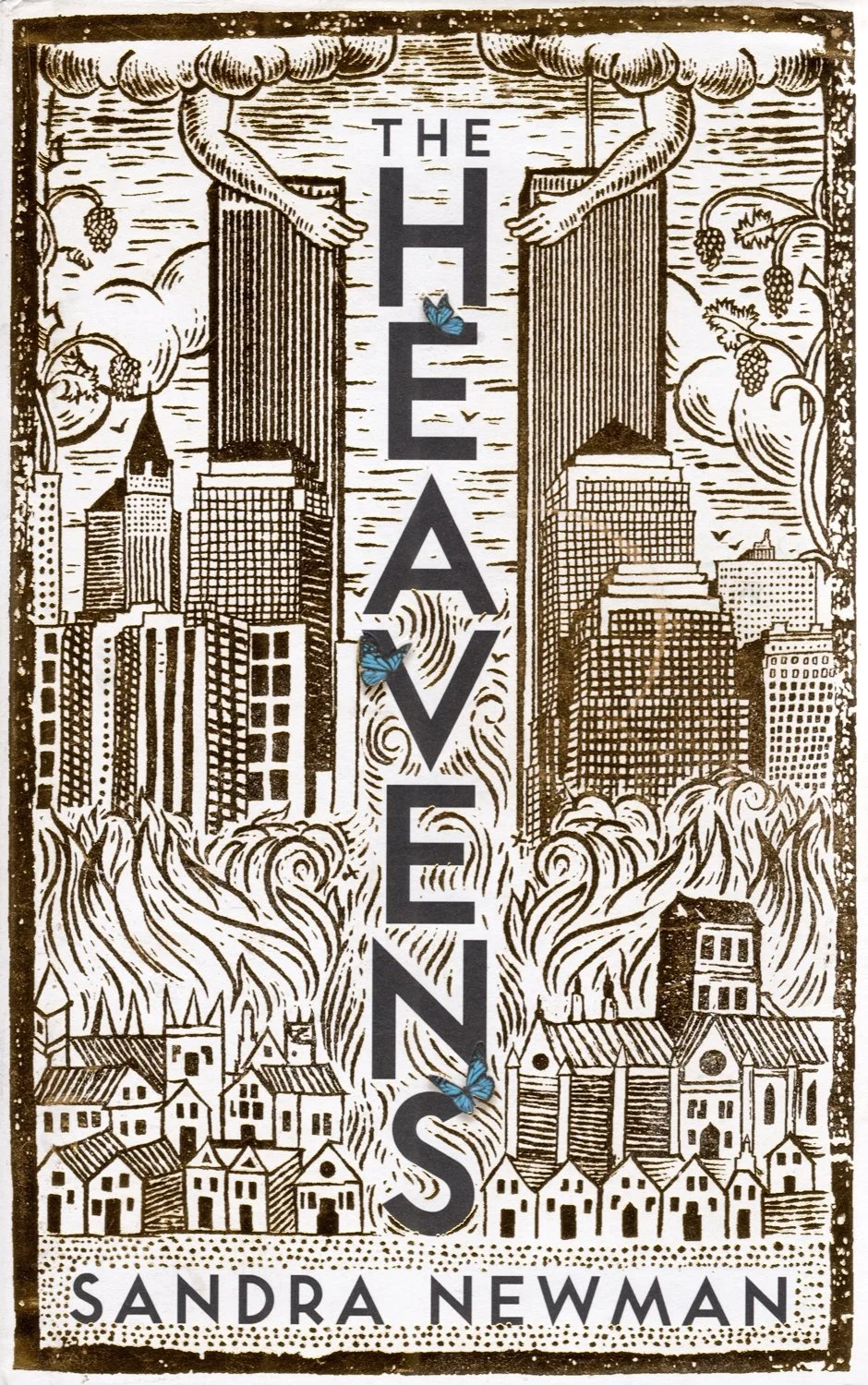
I can see a purpose to this nothingy set-up: it makes our timeline, where Kate eventually arrives, feel more real. Given the cover of the book – and the content of this review – I don’t think it’s a spoiler to say, when Kate catches up with our reality, she does so on the day of 9/11. And indeed, that chapter is gripping in a kind of rich-people-in-peril sort of way, but also due to Kate’s discombobulation, cut adrift from the event’s real-world significance. It is in this chapter where the book’s epic sense of time is severed from a necessary corresponding epic sense of space, and the entire construction suffers as a result. It feels like a boulder dropped into a still lake, a monumental, ripple-causing event that nobody could predict or prevent. When in reality, our reality, it was very much a predictable, preventable ripple in its own right, the result of centuries-long cause-and-effect on an international scale.
The problem is, in order to get there, we first spend three quarters of the book bounced untethered between unrealities, and it gets tiring. Especially as the changes Kate causes aren’t, for quite some time, apparent to anyone but Kate, and being a manic pixie dream girl minus the manic, neither version of her does anything about it. In 2000, she merely observes the variations and tries not to sound too crazy around Ben and Sabine. In 1593, she knows she has to do something to avert catastrophe, but rather than seek out that averting action, she instead fucks Willy Shakes more often than might be expected of a girl with a destiny calling.
Early on, The Heavens goes out of its way to reference the butterfly effect (small actions snowballing into notable events) and the great man theory (history is constructed by the destruction of the status quo by individuals possessing inherent superiority). But even while staring down the barrel of an apocalypse she herself seems to be creating, Kate neither takes actions, even small ones, nor does she attempt to use her unique ability to change the future. The world just sort of happens – and falls apart – around her.
Is there something to pick up here, about complacency making us complicit in creating an imperfect world? Sure there is. Does Newman pick it up? Not really! Is Kate’s lack of agency the direct cause of the degradation of her utopia? Turns out: no! And if you thought this book couldn’t withstand more big ideas, [leans into frame] sir, a fifth high concept has hit the novel.
Shakespeare himself is also a time-traveller – he dreamed into the past to become right hand tactician and fuckboy to Alexander the Great. Alexander dreamed into the past to become Cassandra at Troy. Late in the book, Kate meets another time-traveller, an ex-marine who visits her in his dreams, and he explains – or rather, lore dumps – that he himself is visited by an academic who, in her own time, studies this process of star-crossed time-travellers, and she was visited by the scientists who began the whole fandango, in the process destroying all life, everywhere. All woke from their dreams of the past to a world none could prevent becoming worse, and in return they were rewarded with greatness in their own time.
Kate does by the end of the novel finally step into the beginnings of that greatness, but it very much is thrust upon her narratively, because that’s the maguffin’s reward for not dying in the dystopia she created. Mostly what agency she does exert amounts to taking part in community outreach, which isn’t quite on the same level of Shakespeare, Alexander or Achilles. There’s something to speak on there, too – great men don’t have to be heroes, they can be great women working on the level of social support – but that’s exactly where the book ends, so it’s a thought that never goes anywhere. And still, Kate’s efforts in this realm also only exist thanks to the material support of a somewhat reduced version of a still really quite privileged Sabine, annoyingly the most interesting character, despite her wealth undercutting the book’s political optimism.
So: two unrealities. One stable and endurable, but it happens to be your fated lover’s apocalypse dream come true. One becoming progressively worse, but more like our own reality, with a personal consolation prize at the end. Listen, listen: that should work. It’s majorly depressing. Cynical in the extreme. But it should work.
And yet.
Here comes a side note that’s not really a side note: the ex-marine from the twenty-fifth century describes the academic from the twenty-ninth century as a trans woman, and look, you are not convincing me that our current understanding of gender progresses so little in the next 800 years, that folk in 2800 still describe themselves – or even conceive of themselves – with terminology from the early twenty-first century. And perhaps he’s only using language he knows Kate, in 2000, will understand. But I do think that gets to the crux of my annoyance: in a book explicitly about small actions leading to great changes, nothing changes.
And that’s when it clicked. For a work of time travel and alternate realities, there’s very little that feels genuinely of a different time, or a different world. With that realisation locked in, a whole host of narrative and ideological assumptions wriggled out from under the apparently unpredictable, impossible boulder of 9/11.
A very familiar worldview begins to take shape underneath the story. Empire haunts this book, and not in a good way. Troy. Macedon. Britain. America. The Future. The novel’s core message seems to be: nation states may fall, but love remains. A beautiful, human sentiment.
Unfortunately, sentiment is as far as The Heavens wants to go.
In their meet-cute, Kate and Ben share their heritages – Bengali-Jewish, Hungarian-Persian respectively – but nothing recognisable, material or emotional of this history makes itself known. If they hadn’t divulged their identities in the first chapter, I could have read the entirety of the book assuming they were White Anglo-Saxon Protestants. Their international identities are reduced to more window-dressing. Add to this, The Heavens’ “great men” overwhelmingly fall within the Euro-Western canon. What of the rest of the world – are there no “great men” outside of the global north, do their small actions not domino into great events? Perhaps, but they aren’t the focus of this story.
The colonisation of America isn’t once mentioned, and Native Americans feature nowhere in the initial utopia – or indeed, the entire book. Yet, The Heavens’ utopian New York is structurally identical to our own, albeit with no homeless people and better bagels. So some kind of recognisable history connects all versions of this New York to the real New York, which in the long game is a direct product of colonisation. So in The Heavens’ utopia, the violent settlement of America must have happened, as it did in reality, sometime between Hamlet and the Iraq war; we know the French have something to do with it because everyone’s bilingual, but that’s the only clue you’re getting as to what happened when the West discovered the West.
Perhaps I’m being too harsh? After all, The Heavens was published in 2019. Both its utopia and dystopia might have landed differently with me in a world that was pre-COVID (although pandemics have always shaped history), pre-BLM (although people of colour have always resisted white supremacy), pre-Russian invasion of Ukraine (although empire has always required war), pre-Israeli genocide in Palestine (although Israel has always been, from the beginning, an exercise in extermination), etc and so on. Then again, perhaps the sentiment of The Heavens resonates more fully, if you aren’t in the habit of paying much attention to anything happening beyond the high, high windows of the penthouse party that is middle-to-upper-class North America.
But functionally, there is no distinction here between utopian or dystopian. The world operates as it always has done. Kate’s journey from one to the other feels like watching a Let’s Play of an RPG that lets you bump the sliders during character creation, but none of it ever affects the gameplay. Despite the arc of history bending towards less human strife in general, The Heavens only invokes utopia to imply our current dystopia is all but inevitable. Newman is content to rewrite history, but only if it doesn’t point to a markedly different present.
And if the world tends towards disaster no matter what you do, the only sane approach seems to be not getting too bothered about it.
Party on.